

COMPASS Pilot Aptitude Test: A Practical Guide to the EPST Battery

COMPASS is the pilot aptitude battery developed by EPST, European Pilot Selection & Training, based in Utrecht. Emirates, Etihad, Transavia and a number of cadet academies use it to decide who goes on to interviews and simulator checks. This guide covers where you sit it, what each part measures, who uses it and how to train for it.
COMPASS has no fixed paper. Each academy or airline picks its own modules, which is why Emirates Flight Training Academy and Spice Star Academy describe different sets. Whatever any guide says, including this one, the module list in your own invitation takes priority.
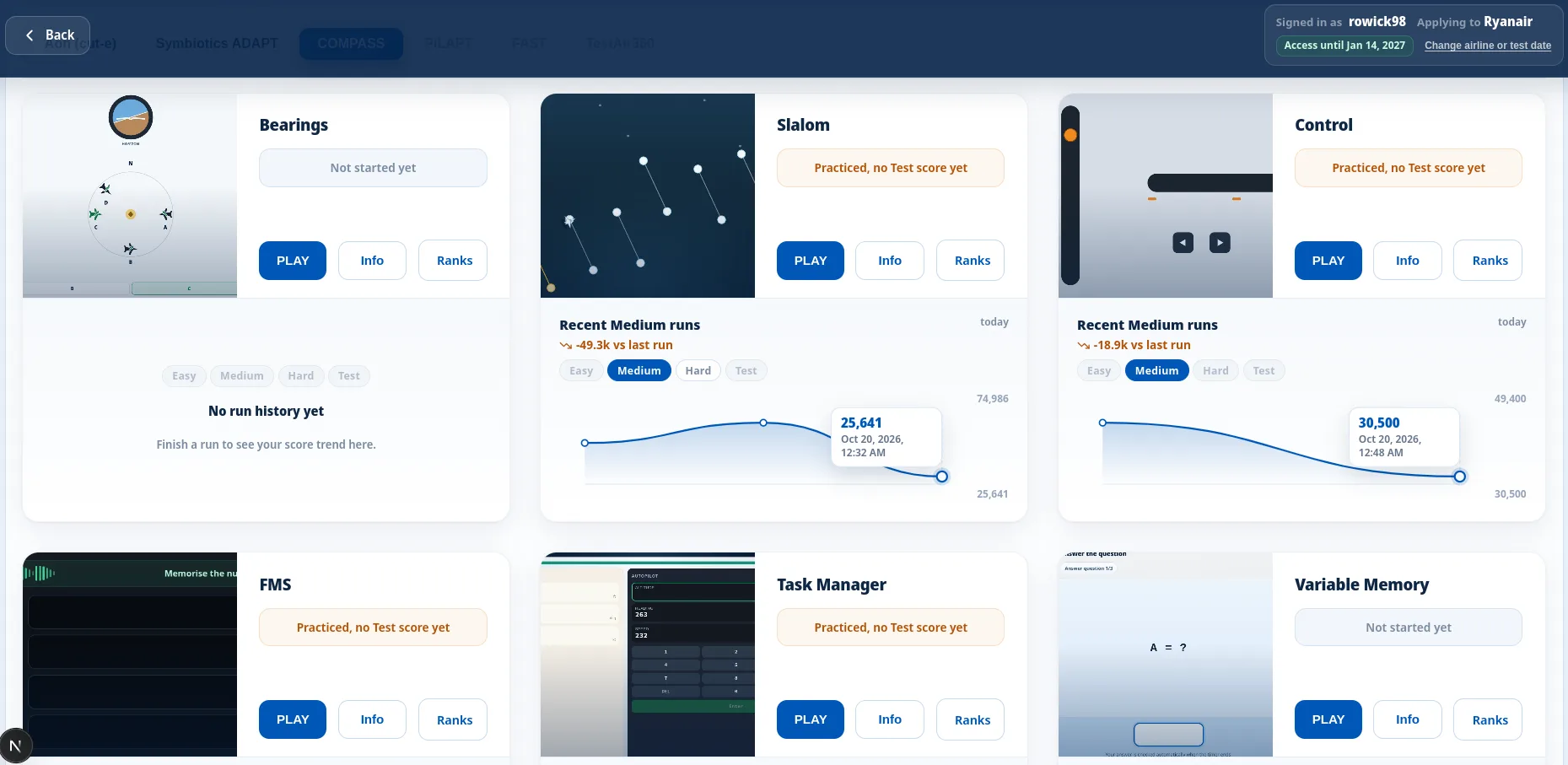
The practice set. Each task is original, timed, and scored. None of them is an item from a live COMPASS test.
COMPASS at a glance
| Item | Detail |
|---|---|
| Developed by | EPST (European Pilot Selection & Training), Utrecht |
| Also written as | Compass, or "tests with EPST" |
| Where you take it | Online, at an assessment centre, or either |
| Length | Not published; depends on the modules chosen |
| Typical use | Cadet academies and pilot selection |
| Not to be confused with | Aon (cut-e), Symbiotics ADAPT |
Where and how you sit it
The format depends on who invited you. Emirates Flight Training Academy runs Compass as an online aptitude test inside its Dubai assessment. Etihad's cadet programme holds it at the assessment centre in Abu Dhabi. Transavia lets candidates take it online or in person at EPST in Utrecht.
At a centre you may work with a joystick and rudder pedals instead of a mouse and keyboard. That changes how the control tasks feel, not the skill behind them, so browser practice still carries over. Expect the hardware to feel strange for the first minute and do not let it rattle you.
No single time limit covers every sitting. An online academy block can run several modules back to back, while a centre day often spreads the aptitude tests around interviews or a simulator check. Your invitation is the only reliable timetable.
The skills COMPASS measures
COMPASS rewards steady, accurate work while the load keeps building. A quick answer only helps if it is right, and holding one instrument perfectly while another drifts costs more than keeping both roughly on target.
The task names in the right-hand column come from our practice set, which is built on candidate and academy reports. They are not official EPST module names, and the timings in our practice are our own.
| Skill area | What you do | Our practice task |
|---|---|---|
| Manual control | Fly a jet through gates while the view rolls and the steering direction flips; keep a moving target under control | Slalom, Control |
| Instrument reading | Combine heading, horizon and beacon needle to find the aircraft's position around a beacon | Bearings |
| Multitasking | Enter altitude, heading and speed into the autopilot while clearing alert lights | Task Manager |
| Listening | Take in spoken, FMS-style instructions and act on them | FMS |
| Memory | Hold changing values and short sequences, then recall them | Variable Memory, Short-term Memory |
| Spatial orientation | Work out direction and position from a changing picture | Spatial Orientation |
| Maths and physics | Solve short calculation and mechanics problems against the clock | Maths, Physics |
Not every sitting includes all seven areas. Full task descriptions are on the COMPASS preparation page.
Airlines and academies that use COMPASS
Batteries change between hiring campaigns, so use this section to orient yourself and your invitation to confirm.









Ryanair, Jet2 and many other carriers screen with Aon (cut-e), and Generation easyJet, Southwest Destination 225° and other CAE cadet routes use Symbiotics ADAPT. If your invitation names one of those, our Aon or ADAPT guide is the better read.
How to train for COMPASS in four steps
You cannot learn the answers in advance: modules vary by programme, and the numbers in the maths and physics tasks change on every run. What you can train is how well you hold up when several jobs compete for your attention.
- Start with your invitation. Note which modules it lists and whether you sit online or at a centre.
- Set a baseline. Run the free practice once, cold, to feel the pace: Slalom, Spatial Orientation, Variable Memory and Short-term Memory.
- Find the job you drop. When the load rises, one task usually slips first. Train that one, not the one you already enjoy.
- Cover the rest of the battery. The full preparation adds Bearings, Control, FMS, Task Manager, Maths and Physics. Each is timed and scored, and the training hub shows how you compare with other candidates and what to practise next.
Try the free COMPASS practice →
One Pilot Preparation subscription covers COMPASS, Aon and ADAPT, so you are covered if a later stage uses a different battery. Practice for PILAPT, FAST and TestAir360 is still in development.
Common questions
What does EPST stand for?
European Pilot Selection & Training, the Utrecht company that develops COMPASS.
Can I take COMPASS from home?
Often, yes. Emirates Flight Training Academy and Transavia both offer an online route, while Etihad's cadet programme uses an assessment centre.
Do I need a joystick to practise?
No. A joystick helps you get used to the feel of a centre sitting, but the skills you build with a mouse or keyboard carry over.
Is COMPASS harder than Aon or ADAPT?
There is no fair ranking: they are separate batteries with different tasks. What matters is which one your invitation names, and training for that one.
Are your tasks the real COMPASS items?
No. They are original exercises that train the same skills under time pressure, not copies of live selection items.
Full preparation access
One subscription covers every pilot assessment we prepare for.
3-month subscription
€24.99 / 3 months
- Continuous updates
- Instant access after receiving payment
- Train from any device with a browser
- Compare your results with other candidates
Related Blog Posts
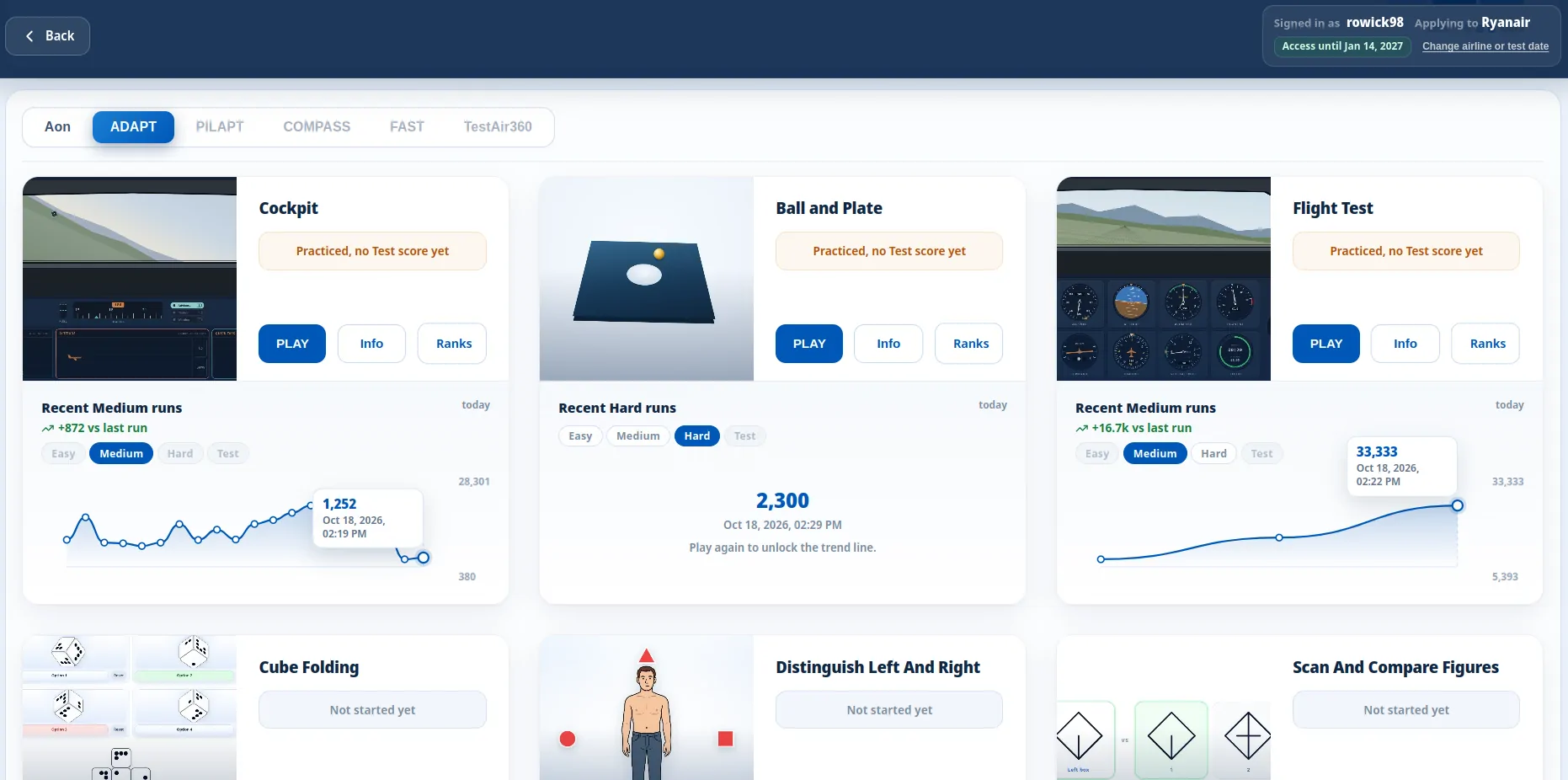
ADAPT Pilot Test Explained: What Symbiotics Screening Covers
Symbiotics ADAPT is the pilot aptitude screen CAE uses on many cadet programmes. The invitation decides which tasks you sit, so two ADAPT sittings can differ.
Read More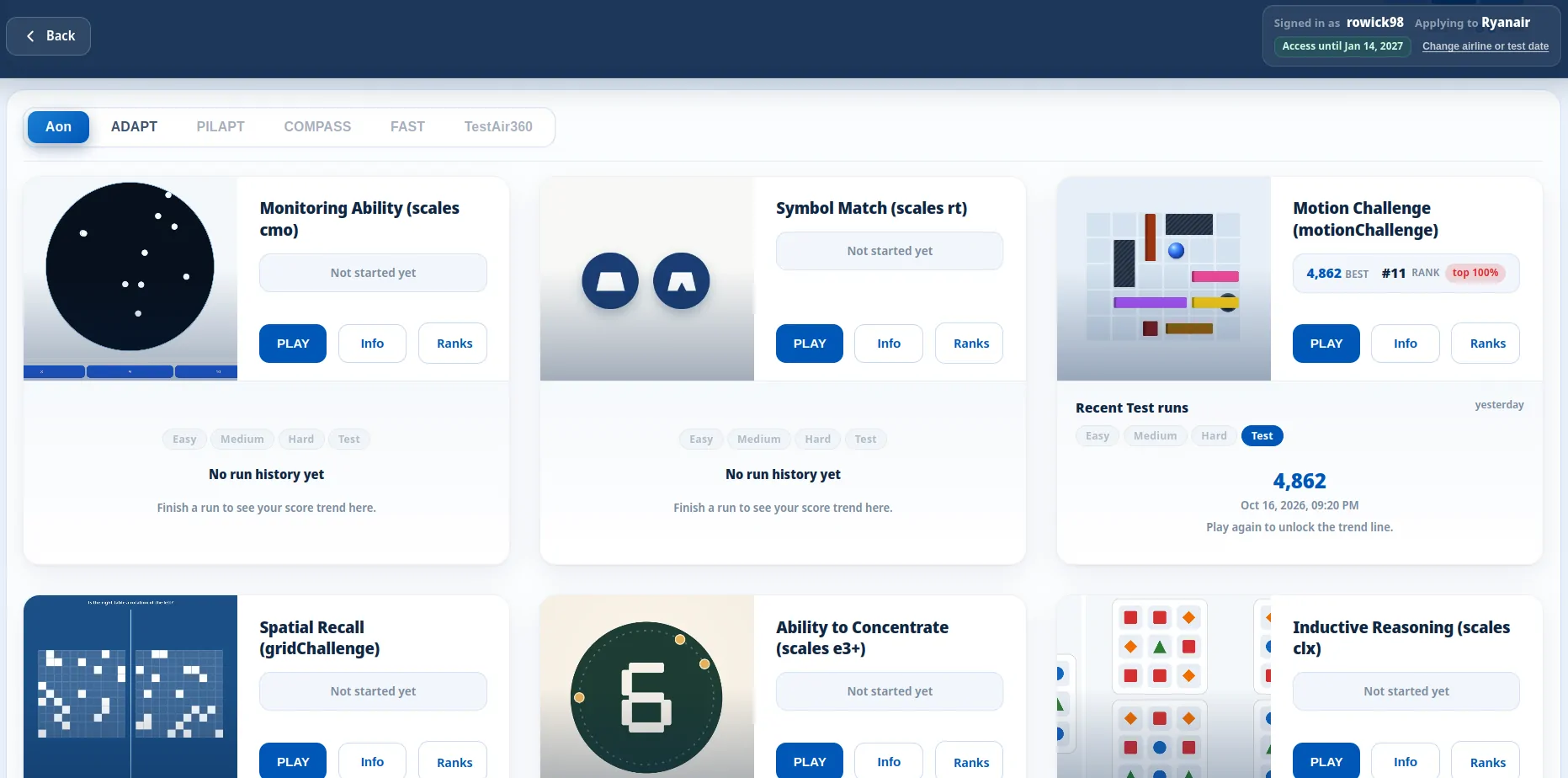
Aon Pilot Test Explained: What cut-e Screening Covers
The Aon pilot test is a set of short timed scales, still often called cut-e. Airlines choose which skills to include, so two sittings can differ.
Read More
Pilot Preparation Is Now Available on ATC Preparation
ATC Preparation now has practice for airline pilot aptitude tests as well as controller selection. Aon (formerly cut-e), Symbiotics ADAPT, and COMPASS are available. PILAPT, FAST, and TestAir360 are planned.
Read More