

Air Traffic Controller Class 3 Medical: What the EASA Exam Checks

A Class 3 medical certificate is the medical certificate every student and licensed air traffic controller must hold. In the EU it is set by Part ATCO.MED, Annex IV of Commission Regulation (EU) 2015/340, and it has to be renewed throughout a controller's career. This guide sets out what that rule checks and how long a certificate lasts.
The figures below come from the consolidated text EASA publishes as its Easy Access Rules for ATCO licensing (revision from March 2024, PDF corrected in July 2024), checked on 18 November 2026. The UK Civil Aviation Authority publishes a parallel Class 3 process for UK licences. Your aero-medical examiner, not this page, decides whether you are fit.
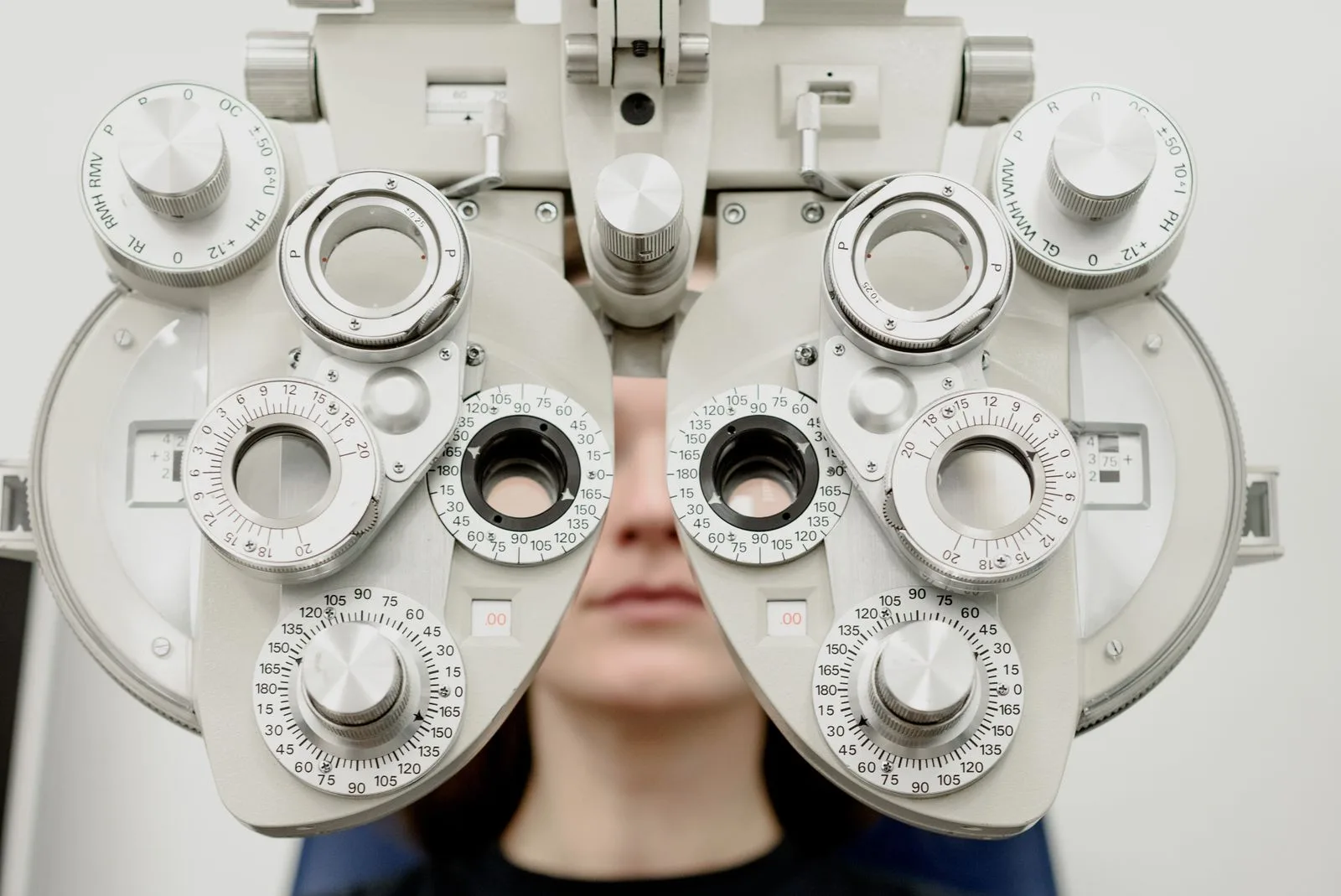
Photo: Ksenia Chernaya / Pexels. An eye examination in an optometry clinic, not an aero-medical centre.
Who needs a Class 3 medical and who issues it
Point ATCO.MED.A.030 is short: anyone applying for or holding an air traffic controller licence or a student air traffic controller licence must hold a Class 3 medical certificate. Since 4 August 2024 there is one exception, for privileges used only in a synthetic training device. A licence holder may hold only one such certificate at a time.
The first certificate has to come from an aero-medical centre (AeMC). Later revalidations and renewals can be done by an AeMC or by an individual aero-medical examiner (AME). At every visit you bring proof of identity and sign a declaration of your medical history, including any earlier application and any time you were assessed as unfit.
Employers place the medical at different points of selection. NATS asks applicants to be able to complete an initial Class 3 assessment in full, and assigns a start date only once that clearance is through. skeyes requires candidates to be medically certified as air traffic controllers and says failing the medical excludes you from training. ŘLP ČR and DFS both point candidates to Regulation 2015/340 itself.
Eyesight standards for air traffic controllers
The binding vision standard is in ATCO.MED.B.070:
- Distant visual acuity of 6/9 (0.7) or better in each eye separately, and 6/6 (1.0) or better with both eyes, with or without correction.
- Reading an N5 chart at 30 to 50 cm and an N14 chart at 60 to 100 cm, with correction if needed.
- Normal visual fields and normal binocular function. Diplopia (double vision) is disqualifying.
- Initial applicants with monocular vision, or with acquired substandard vision in one eye, are assessed as unfit.
Glasses and contact lenses are allowed. The rule asks for one pair of spectacles that covers every distance while you work, with a similar spare pair at hand. Contact lenses must be mono-focal and non-tinted, and monovision or orthokeratology lenses are not permitted.
The refraction limits sit in the acceptable means of compliance (AMC) for that point. A refractive error between +5.0 and -6.0 dioptres can be assessed as fit if correction is optimal and no significant pathology is found, with a four-yearly eye specialist follow-up once the error exceeds +3.0 or -3.0. Beyond -6 dioptres, or with more than 3 dioptres of astigmatism or anisometropia, a fit assessment is still possible but needs 6/6 in each eye with correction and a two-yearly specialist review. Refractive surgery can also be considered once the refraction is stable and an ophthalmologist has evaluated the eye. Employers can be stricter in what they publish: DFS, for example, states a limit of +5/-6 dioptres including astigmatism.
Colour vision: normal trichromacy
ATCO.MED.B.075 is a single sentence: applicants must be normal trichromates. EASA's AMC adds that pseudoisochromatic plates, the dotted Ishihara-style charts, are not sufficient on their own. The guidance names two accepted ways to show normal trichromacy: anomaloscopy (Nagel or equivalent), passed with a trichromatic match and a matching range of four scale units or less, and the Colour Assessment and Diagnosis (CAD) test.
That matters for anyone who has only ever been checked with plates at an optician. A plate test you passed elsewhere does not settle the question for a Class 3 certificate.
Hearing and ENT checks
Hearing is tested at every examination. The basic test is conversational speech: you must understand it correctly with each ear at 2 metres, with your back to the examiner. Pure-tone audiometry is added at the initial exam. Under ATCO.MED.B.080 the hearing loss in either ear may not exceed 35 dB at 500, 1,000 or 2,000 Hz, or 50 dB at 3,000 Hz. An applicant outside those values is referred to the licensing authority for a specialist assessment, and initial applicants then also sit a speech discrimination test.
What else the initial exam includes
The UK Civil Aviation Authority publishes a plain list for its own initial Class 3 examination, which follows the same regulation: a full physical examination, detailed eyesight tests including colour vision, a resting ECG, spirometry for lung function, an audiogram, urine testing and a blood test for lipids. The CAA says the appointment at an aeromedical centre can take up to four hours.
Behind that list is a general rule in ATCO.MED.B.005. You must be free of any condition, injury, after-effect of surgery or medication side effect that could interfere with safe performance or make you suddenly unable to work. The regulation then has separate sections for the cardiovascular, respiratory, digestive, metabolic, blood, genitourinary, musculoskeletal and neurological systems, as well as psychiatry, psychology, dermatology and oncology. DFS names diabetes as an example of a condition that can rule a candidate out and suggests asking an aviation doctor first.
Declare everything. The CAA asks applicants to bring reports from their family doctor or specialist for any major illness, and to declare minor events such as appendicitis or a broken arm as well. LVNL invites candidates who are unsure about a medical condition, medication or a physical limitation to contact its recruitment team before applying.
How long a Class 3 medical is valid
ATCO.MED.A.045 sets validity at 24 months, falling to 12 months for licence holders aged 40 or over. A certificate issued before your 40th birthday stops being valid when you turn 41. Several tests also run on their own schedule:
| Item | Before the age threshold | After it |
|---|---|---|
| Class 3 certificate | 24 months | 12 months from age 40 |
| 12-lead resting ECG | Initial exam, then every 4 years until age 30 | At every revalidation or renewal after that |
| Pure-tone audiometry | Initial exam, then every 4 years until age 40 | Every 2 years after age 40 |
| Tonometry (eye pressure) | Included in the initial comprehensive eye exam | At the first revalidation after age 40 |
You can revalidate up to 45 days before the expiry date, and the new period then runs from the old expiry date. Miss that window and you need a renewal instead. If the certificate lapsed less than two years ago, a routine revalidation examination applies. After more than two years, the examiner reviews your aero-medical records first, and after more than five years the initial-issue examination requirements apply again.
Before you apply
If eyesight, colour vision or a past illness worries you, an appointment with an AME or AeMC before you put time into selection is the reliable way to find out. Print the relevant points of Part ATCO.MED and take them to your doctor, as the CAA suggests. Then check the medical step of the employer you are applying to, because NATS, skeyes and others place it at different points of the process.
The medical is only one of the hurdles. Aptitude testing is usually a separate step. ŘLP ČR, for example, uses EUROCONTROL's FEAST tests in its selection, and our FEAST preparation software lets you practise that stage with original tasks, not the official test. For the full path from application to licence, read how to become an air traffic controller.
Official sources
- EASA: Easy Access Rules for Air Traffic Controllers' Licensing and Certification (Regulation (EU) 2015/340)
- UK CAA: Initial medical certification for air traffic controllers
- NATS: Trainee Air Traffic Controllers
- skeyes: Entrance requirements
- DFS: Anforderungen für die Fluglotsen-Ausbildung (German)
- ŘLP ČR: Požadavky (Czech)
- LVNL: Veelgestelde vragen (Dutch)
All pages checked on 18 November 2026.
Related Blog Posts

FAA Academy Basics for ATC Course: What New Controllers Study and Must Pass
Most new FAA air traffic control trainees start with Basics for ATC, a 19-day course at the FAA Academy in Oklahoma City. This guide covers what the course teaches, the 70 percent exam trainees must pass, and who may choose to skip it.

Generation easyJet Pilot Assessment: ADAPT Test, Group Exercise and Interview
CAE and easyJet select Generation easyJet cadets in three stages: an application check, the ADAPT pilot aptitude test, and a group exercise with an interview. This guide covers each stage, the entry rules and the re-assessment policy CAE publishes.

ELPAC Test for Air Traffic Controllers: Format, Scoring and ICAO Levels
ELPAC is EUROCONTROL's English language proficiency test for air traffic controllers and pilots. This guide explains the listening and speaking papers, how the ICAO level is decided, and how long an EASA language endorsement stays valid.