

EASA Class 1 Medical Certificate: What Commercial Pilots Must Pass

A Class 1 medical certificate is the medical certificate required to exercise a commercial pilot licence (CPL), a multi-crew pilot licence (MPL) or an airline transport pilot licence (ATPL) under EASA rules. The requirement sits in point MED.A.030 of Annex IV (Part-MED) to Commission Regulation (EU) No 1178/2011. This guide sets out what that rule checks and how long a certificate lasts.
The figures below come from the consolidated text EASA publishes as its Easy Access Rules for Aircrew, revision from October 2026, checked on 20 November 2026, together with EASA's medical FAQ. The UK Civil Aviation Authority publishes a parallel Class 1 process for UK licences, which is not an EASA certificate. Your aero-medical examiner, not this page, decides whether you are fit.
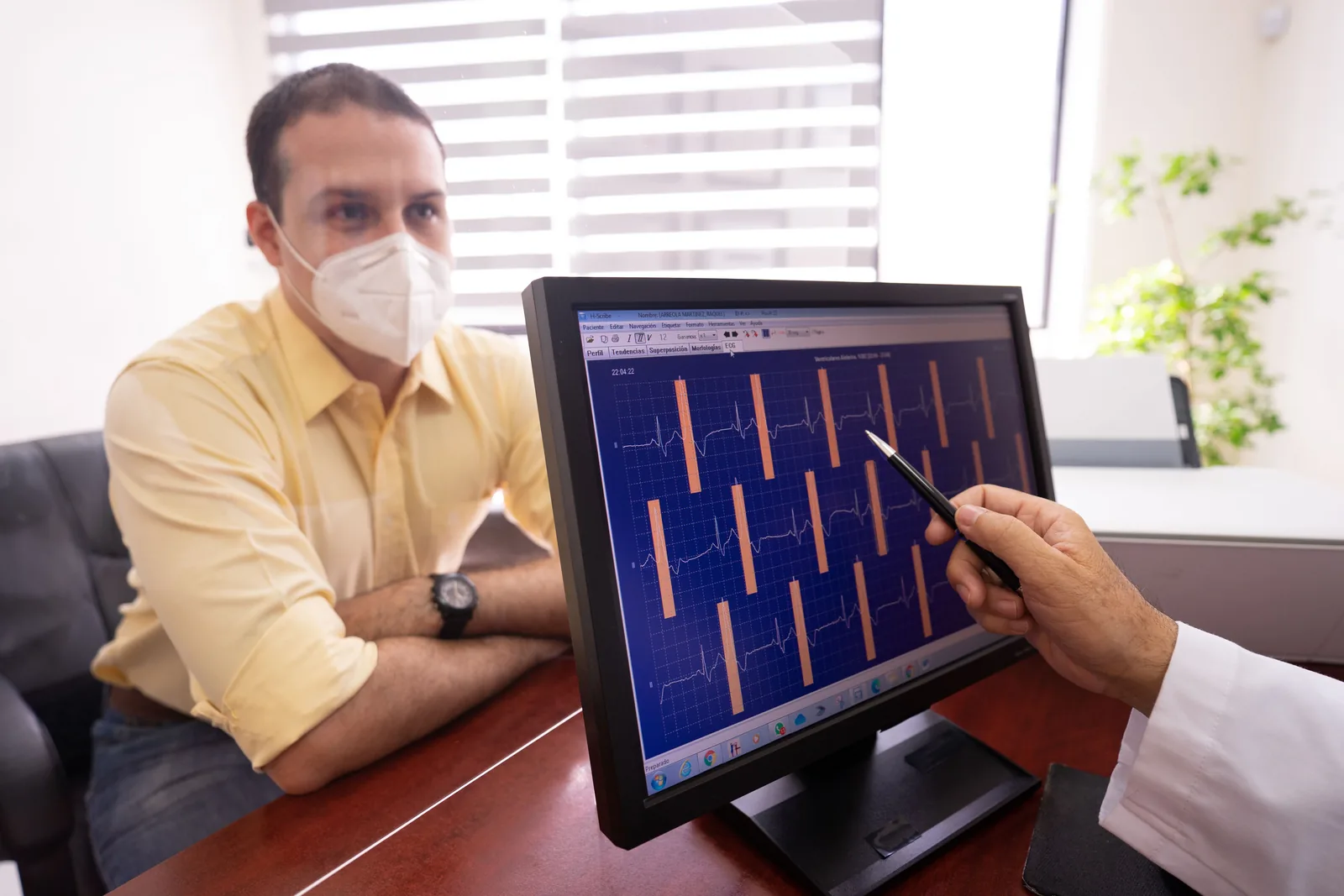
Photo: Los Muertos Crew / Pexels. An electrocardiogram being reviewed in a clinic, not an aero-medical centre.
Who needs a Class 1 medical and who issues it
Point MED.A.030(c)(5) is direct: when exercising the privileges of a CPL, MPL or ATPL, the pilot shall hold a valid Class 1 medical certificate. A student pilot may not fly solo without the medical certificate required for the relevant licence. A licence holder may not hold more than one Part-MED medical certificate at a time.
A Class 1 certificate includes the privileges and validities of Class 2 and LAPL medical certificates, according to the acceptable means of compliance for that point. EASA's FAQ adds the practical consequence: a Class 1 certificate lets you exercise PPL privileges. A Class 3 certificate, which is the medical for air traffic controllers, does not include Class 2 privileges and cannot be used for a PPL.
The first Class 1 certificate has to be issued by an aero-medical centre (AeMC). Later revalidations and renewals can be done by an AeMC or by an aero-medical examiner (AME). EASA does not keep a central list of AeMCs or AMEs; it tells applicants to use the list published by the competent authority of the Member State where they plan to apply. A certificate issued by an AME authorised by an EASA State is recognised in the other Member States without a further validation step, the FAQ says. At every visit you bring proof of identity and a signed declaration of your medical history, including any earlier application and any previous aero-medical examination.
How long a Class 1 medical is valid
Under MED.A.045, a Class 1 certificate is valid for 12 months. That period shortens to six months for licence holders aged 60 or over, and for licence holders aged 40 or over who are engaged in single-pilot commercial air transport operations carrying passengers. For an initial issue or a renewal, the period is calculated from the date of the aero-medical examination. For a revalidation it runs from the expiry date of the previous certificate.
You may attend for revalidation up to 45 days before the expiry date. Miss that window and you need a renewal instead. If a Class 1 certificate has been expired for less than two years, a routine revalidation examination is performed. After more than two years but less than five, the AeMC or AME first assesses your aero-medical records. After more than five years, the initial-issue examination requirements apply, and the assessment is based on the revalidation requirements.
| Item | Standard interval | Shorter interval |
|---|---|---|
| Class 1 certificate | 12 months | 6 months from age 60, or from age 40 in single-pilot commercial air transport carrying passengers |
| 12-lead resting ECG | Initial exam, then every 5 years until age 30, every 2 years until 40, annually until 50 | At every revalidation or renewal after age 50 |
| Serum lipids, including cholesterol fractions | Initial examination | First examination after age 40 |
| Pure-tone audiometry | Initial exam, then every 5 years until age 40 | Every 2 years until 60, then every year |
Those investigation intervals come from MED.B.010 and MED.B.080. An extended cardiovascular assessment is also required at the first revalidation or renewal after age 65, and every four years thereafter, or earlier when clinically indicated.
Eyesight and colour vision
For a Class 1 certificate, a comprehensive eye examination is part of the initial examination and is repeated periodically, depending on refraction and how the eye performs. A routine eye examination forms part of every revalidation and renewal. Distant visual acuity, with or without correction, must be 6/9 (0.7) or better in each eye separately, and 6/6 (1.0) or better with both eyes. Initial applicants with substandard vision in one eye are assessed as unfit. Applicants must also be able to read an N5 chart or equivalent at 30 to 50 cm and an N14 chart or equivalent at 100 cm, with correction if needed.
Refractive error does not automatically mean a fail, but some cases are referred to the medical assessor of the licensing authority: myopia exceeding -6.0 dioptres, astigmatism or anisometropia exceeding 2.0 dioptres, and hypermetropia exceeding +5.0 dioptres. In the last of those, a fit assessment also requires corrected acuity of 6/6 or better in each eye, adequate fusional reserves, normal intraocular pressures and anterior angles, and no significant pathology. Diplopia is disqualifying. Applicants who have had eye surgery are assessed as unfit until visual function has fully recovered and an ophthalmological evaluation is satisfactory. If you need correction, no more than one pair of spectacles may be used to meet the visual requirements, and a spare pair of similarly correcting spectacles must be readily available. Contact lenses worn when flying must be for distant vision, monofocal, non-tinted and well tolerated. Orthokeratology lenses are not permitted.
Colour vision is first checked with the Ishihara test. Applicants who pass may be assessed as fit. Those who do not pass, on a Class 1 application, are referred to the medical assessor and must undergo further testing to show that they are colour safe. For Class 1, applicants shall be normal trichromats or colour safe; failing the further tests means an unfit assessment. The acceptable means of compliance treat the 24-plate Ishihara test as passed if the first 15 plates, shown in random order, are identified without error, and they name anomaloscopy, certain lantern tests, and the Colour Assessment and Diagnosis (CAD) test as further options.
Hearing, the heart and the rest of the initial exam
Hearing is tested at every examination. For Class 1, pure-tone audiometry is required at the initial exam, then every five years until age 40, every two years until 60, and every year after that. Initial applicants may not have a hearing loss of more than 35 dB at 500, 1,000 or 2,000 Hz, or more than 50 dB at 3,000 Hz, in either ear separately. A comprehensive ear, nose and throat examination is undertaken for the initial Class 1 certificate. The acceptable means of compliance also expect applicants to understand conversational speech correctly with each ear at two metres, with their back turned to the examiner.
A standard 12-lead resting ECG and report are required at the initial Class 1 examination, then on the schedule in the table above, and whenever clinically indicated. Estimation of serum lipids, including cholesterol fractions, is required at the initial examination and at the first examination after age 40. Behind those specific tests is the general rule in MED.B.005: applicants are assessed as unfit if an abnormality, disease, injury, after-effect of surgery, or the effect of medication is likely to interfere with the safe exercise of the licence or could make them suddenly unable to do so.
The UK Civil Aviation Authority, describing its own initial Class 1 appointment, says a visit to an AeMC may take up to four hours. Besides medical history, colour vision, eyesight, a general physical examination, audiometry and an ECG, it lists spirometry, a finger-prick haemoglobin test, a lipids test and a urine test. Treat that list as the CAA's description of the UK appointment, not as a substitute for EASA Part-MED in an EU Member State.
Before you book the exam
If eyesight, colour vision or a past illness worries you, an appointment with an AeMC or AME is the reliable way to find out before you spend time and money on flight training. Print the relevant points of Part-MED and take them to your doctor, as the CAA suggests for its own process. Then use the list of AeMCs published by the competent authority of the State where you will apply.
The Class 1 medical is only one requirement for a professional licence. It is also a different certificate from the Class 3 medical that air traffic controllers hold. Our guide to the air traffic controller Class 3 medical explains that exam. For airline selection that comes after the medical, start with a named battery such as the Aon pilot test or the ADAPT pilot test.
Official sources
- EASA: Easy Access Rules for Aircrew (Regulation (EU) No 1178/2011), revision from October 2026
- EASA: medical FAQ
- UK CAA: Initial Class 1 medical examination
All pages checked on 20 November 2026.
Related Blog Posts

Qantas Group Pilot Academy Selection: Moodle Exam, Aon Cut-e Test and Interview
Flight Training Adelaide selects Qantas Group Pilot Academy students with a theory exam, a nine-module Aon cut-e assessment and a 90-minute interview in Toowoomba. Pass marks, fees and wait times from the 2026 guide.

IndiGo Cadet Pilot Program Selection: ADAPT Test, Group Task and Interview
IndiGo selects cadets through partner flight schools, starting with the Symbiotics ADAPT aptitude test and ending with an IndiGo group task and interview. Eligibility, the eight ADAPT tests and the attempt rules, by source.

Emirates Flight Training Academy Assessment: HireVue, Compass Test and Dubai Selection Days
Emirates Flight Training Academy screens international cadets online, then tests maths, physics and the Compass pilot aptitude battery in Dubai. Requirements, steps and fees as the academy published them.