

Avinor Air Traffic Controller Selection: FEAST Tests, Interview and Training

Avinor Flysikring AS trains air traffic controllers for Norway. Unlike several European employers, it publishes no upper age limit. Admission is built around two in-person computer-based test days at Trondheim Airport, Værnes, an interview in Oslo, and a Class 3 medical. All four phases have to be passed for a training place to be offered.
This guide is based on Avinor's English careers pages and its Norwegian FAQ, checked on 20 November 2026. On that date the English pages stated that applications for the 2027 training programme were due to open on 14 November, with a deadline of 15 February 2027, and that the application link would be published on the same pages when admissions opened. Check Avinor's site for the live link and the current status before you apply.
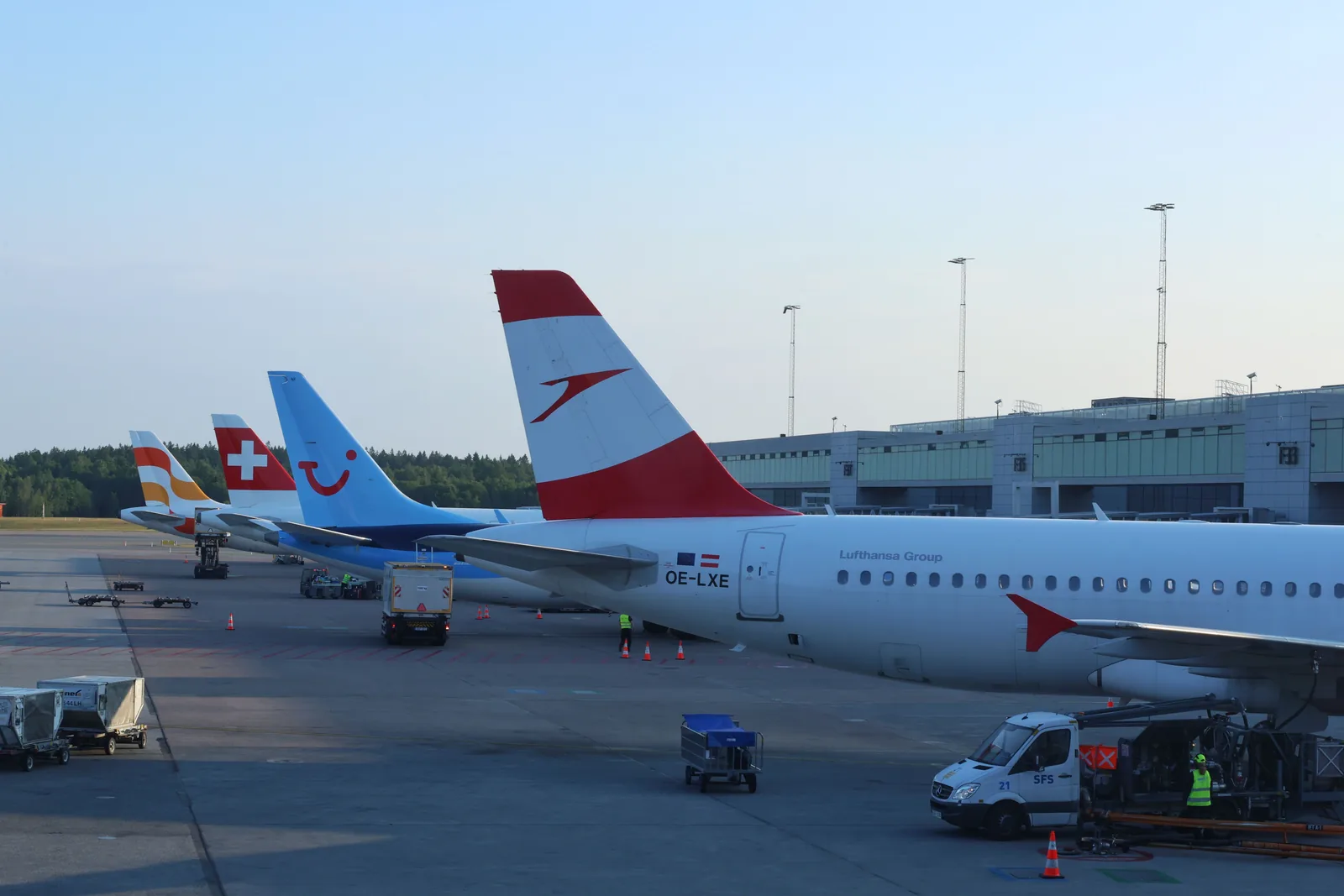
Photo: Jess Chen / Pexels. Aircraft at Oslo Airport, used here as an illustration of Avinor's airport network.
Who can apply
Avinor's admission requirements page says you must be at least 19 years old as of 1 January in the admission year. There is no upper age limit. The FAQ is blunt about the lower limit: if you are 18 and will turn 19 during the admissions year, you will probably have to wait for the next intake. You also have to have finished upper secondary school when you apply. Avinor says its process ends in late May and that it cannot invite people to the test phases without final course and exam grades.
The academic bar is an average grade of 4.0 or better from upper secondary school, calculated from every grade on the diploma, with no extra points for age, science subjects, language, gender or similar. Avinor follows the regulations of Samordna opptak, the Norwegian Universities and Colleges Admission Service, for general university admissions certification and for the average. The FAQ says the average is worked to one decimal place, so 3.95 is rounded up to 4.0, and 4.0 is an absolute requirement. Avinor now also accepts a passed vocational and journeyman's certificate with the same 4.0 average, provided VG1 and VG2 are documented; if the applicant completed three years of upper secondary training before in-company training, all three years count in the average.
There is a discrepancy on one alternative route. The requirements page refers to the 23/6 rule and to new rules from 2027 for admission to higher education. The English and Norwegian FAQs still refer to the 23/5 rule. In both places Avinor says it follows Samordna opptak and that the grade requirement stays 4.0 or better. Use Samordna opptak and Avinor's requirements page for the rule that applies to your year.
Language rules are specific. Spoken and written Norwegian must be documented from upper secondary school with an average grade of at least 3. Spoken and written English needs a minimum grade of 3. Applicants with diplomas from abroad are assessed against Samordna opptak criteria and must have passed the Norwegian CEFR language test at B2 or better. Avinor also requires that you can obtain security clearance at a minimum level of CONFIDENTIAL, and that you meet the requirements for a Class 3 medical certificate.
Compulsory military service is no longer a barrier to applying. Avinor says the old requirement has been removed, and that people who are offered a place receive a conditional exemption from initial military service for as long as they are air traffic controller students.
The four admission phases
Phase 0 is a review of the application and the attached documents against those requirements. Everyone who meets them is invited to Phase 1.
Phases 1 and 2 are computer-based entrance exams, both taken in person at Trondheim Airport, Værnes, and both in English. Everyone who passes Phase 1 is invited to Phase 2. After all Phase 2 candidates have sat the test, Avinor decides, from the results of both phases, who is invited to the interview. The admission-phases page says the tests look at these qualities:
- Three-dimensional visualisation (spatial awareness)
- Quick perception
- Concentration
- Simultaneous capacity (handling several tasks or sources of information at once)
- Decision-making
- Coordination
- High stress tolerance
- Teamwork
Phase 3 is an interview in Oslo, conducted in Norwegian, and it also requires an in-person appearance. You must bring documentation that you meet the admission requirements, and diplomas must be originals or official duplicates; a copy is not enough, because Avinor already has the copy from the application and wants to check it against the original.
Phase 4, for those who pass the interview, is a medical examination in Oslo, completion of the security-clearance application, and an information meeting. The medical is in Oslo; the rest is conducted digitally. A training place is offered only if Phase 4 is passed.
The tests are FEAST, and they cannot be retaken
Avinor's FAQ names the test battery: FEAST, the First European Air Traffic Controller Selection Test, developed by EUROCONTROL. The tests are taken in English on a PC. Avinor says no special prior knowledge or preparation is necessary. It also points applicants to EUROCONTROL's practice platform, notes that the practice tasks are not identical to the real tests, and repeats EUROCONTROL's advice to complete all the exercises two or three times and not to practise for more than eight hours, because more than that can make it harder to adapt on the day.
Failed tests cannot be retaken. The FAQ is explicit: it is not possible to sit the admissions tests again, including if you have already taken them through someone other than Avinor Flysikring AS, because the same tests are used throughout Europe. That is stricter than EUROCONTROL's own MUAC campaign, which allows a second FEAST attempt after two years. If you might apply to more than one FEAST employer, check each organisation's retake rule before you book a date.
Official practice is on EUROCONTROL's FEAST training platform. Our guide to the FEAST test explains the battery, and our FEAST preparation software offers original practice tasks, not the official test.
Training, pay and obligatory service
Training lasts about two years. The first year, about nine months over two semesters, is at the Czech Air Navigation Institute (CANI) in Prague and covers basic education and simulator training with instructors. Avinor Air Navigation Services pays the tuition and materials. Students pay their own travel and living costs and can apply to the Norwegian State Educational Loan Fund (Lånekassen); the Prague year is approved as a nine-month course under the usual terms for study abroad.
After that year, students return to Norway, are temporarily employed by Avinor Flysikring AS, and receive trainee pay. A short transition course of about two to three weeks covers Norwegian rules and regulations, system training and meteorology. Practical training then lasts about one to one and a half years at a control tower or a control centre in Norway, mainly as supervised training with experienced controllers, plus local procedures and simulator work. Avinor does not take individual wishes into account when it assigns the on-the-job training unit or the later service location.
People who pass the spring tests and are offered a place can, in principle, expect to start in the autumn of the same year. Avinor's Norwegian FAQ gives trainee pay as 451,200 kroner as of 1 October 2026, written in the Norwegian style as 451.200,-, and a starting salary for a newly qualified controller of 703,000 kroner on the same date. Annual pay then depends on the unit and on seniority. After training there is a three-year obligatory service period at the unit Avinor determines. Once those three years are over, you may apply to transfer, subject to staffing at your unit and to an open post at the place you want.
The Class 3 medical is covered in our Class 3 medical guide. Avinor's FAQ also discusses vision correction: farsightedness of less than +5 dioptres or nearsightedness of less than -6 is accepted, and if you have had vision surgery the values from before the operation apply. Health requirements are set by the Norwegian Civil Aviation Authority, not by Avinor itself.
Official sources and related guides
Confirm the application dates and the live application link on Avinor's own pages. For comparison with other European employers, see air traffic controller age limits, EUROCONTROL Maastricht selection and initial training in Europe.
- Avinor: Become an air traffic controller
- Avinor: admission requirements
- Avinor: admission phases
- Avinor: about the education
- Avinor: frequently asked questions (English)
- Avinor: ofte stilte spørsmål (Norwegian)
- EUROCONTROL: FEAST training platform
All pages checked on 20 November 2026.
Related Blog Posts
Qantas Group Pilot Academy Selection: Moodle Exam, Aon Cut-e Test and Interview
Flight Training Adelaide selects Qantas Group Pilot Academy students with a theory exam, a nine-module Aon cut-e assessment and a 90-minute interview in Toowoomba. Pass marks, fees and wait times from the 2026 guide.
IndiGo Cadet Pilot Program Selection: ADAPT Test, Group Task and Interview
IndiGo selects cadets through partner flight schools, starting with the Symbiotics ADAPT aptitude test and ending with an IndiGo group task and interview. Eligibility, the eight ADAPT tests and the attempt rules, by source.
Emirates Flight Training Academy Assessment: HireVue, Compass Test and Dubai Selection Days
Emirates Flight Training Academy screens international cadets online, then tests maths, physics and the Compass pilot aptitude battery in Dubai. Requirements, steps and fees as the academy published them.