
What Happens If You Fail the SureSelect Test

Train with Preparation Software for SureSelect
Practise detail accuracy, coded reasoning, memory, spatial reasoning, and radar simulation in the SureSelect Preparation Suite. The tasks are original practice, not the official SureSelect test.
A failed SureSelect round ends that application. It does not have to end your attempt to become a controller. SureSelect is the selection system Airways International sells to air navigation service providers, and each employer that buys it decides how long you wait, how often you can try again, and whether a result from one campaign counts in the next.
The clearest published rules come from Airways New Zealand, whose own recruitment process SureSelect grew out of. Other employers set their own. This guide uses Airways International's pages as they stood on 21 November 2026.
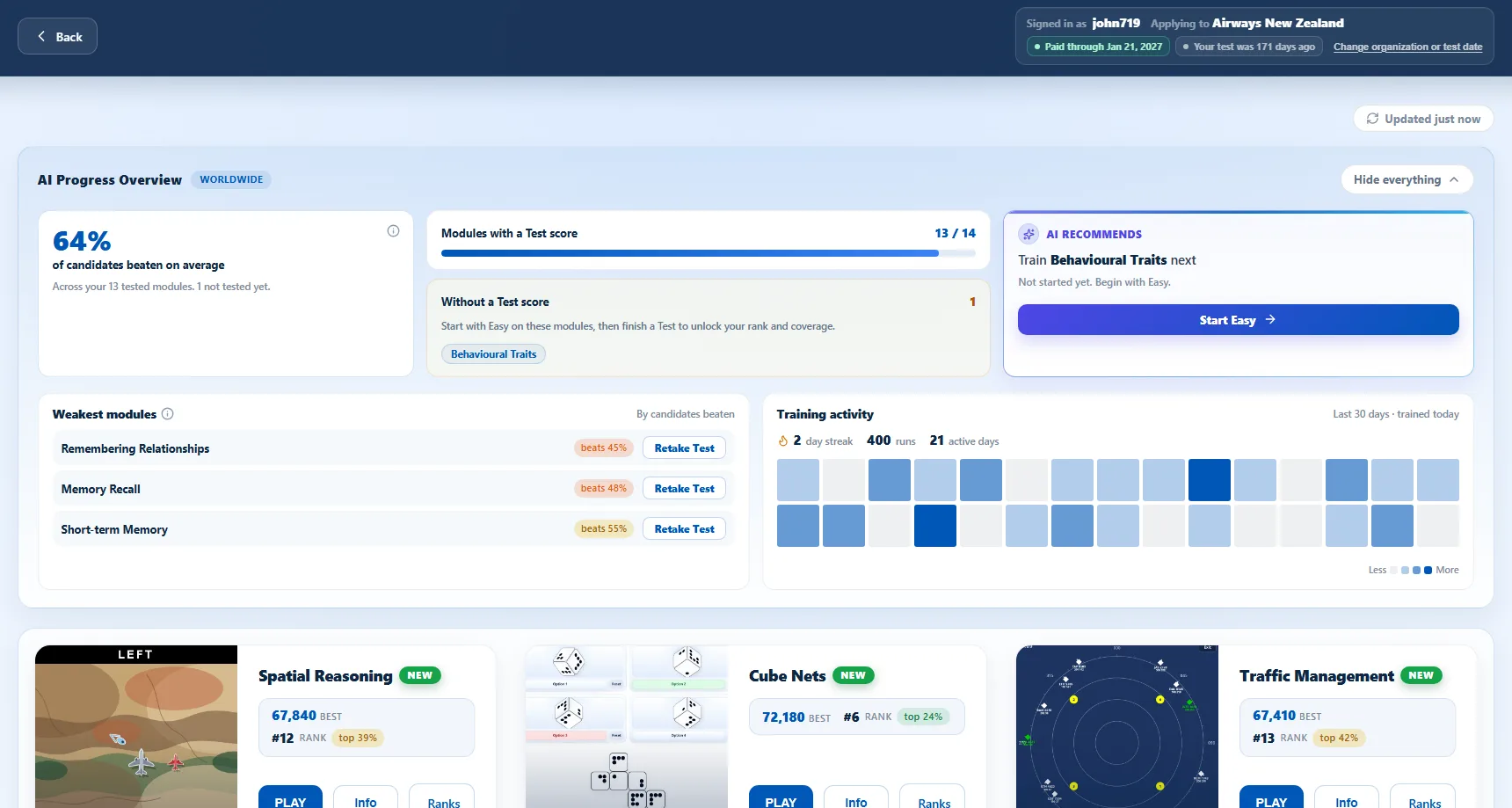
Screenshot from the SureSelect Preparation Suite on this site. Independent practice, not an official SureSelect result.
Which SureSelect round you failed
What happens next depends on where you stopped. In the model Airways describes for its own New Zealand recruitment in its January 2026 article on ATC selection, candidates move through three online rounds and then an assessment centre:
- Cognitive ability. About 45 minutes. Airways says roughly 20% of candidates are eliminated here.
- ATC skill simulations. Only candidates who passed the first round are invited.
- Behavioural traits. A questionnaire on how you work.
- Assessment centre. Airways puts the chance of a training place at about 50-50 for candidates who reach this stage.
A no after an online round and a no after the assessment centre are treated differently, as the next section shows. Your rejection email usually tells you which stage you reached. If it does not, ask the recruiter before you plan anything.
Re-applying at Airways New Zealand
Airways International runs the ab initio academy that trains controllers for Airways New Zealand. Its ATC training FAQ sets three rules:
- One application per intake. If you are unsuccessful, you can apply again once the next intake opens. Intakes usually start in April and October.
- An 18-month stand-down after an assessment centre. A candidate turned down at the assessment centre has to wait 18 months before re-applying.
- Two assessment centres at most. A candidate who is unsuccessful at the assessment centre twice is no longer eligible.
So the online rounds can be attempted again within months, while the assessment centre is a resource you can spend only twice. The same FAQ warns that you may not hear back for several months after you apply, so the real gap between attempts can be longer than the intake calendar suggests.
The full selection route, the fees and the entry rules are in our Airways New Zealand trainee selection guide.
What Airways says about repeat attempts
Airways International is blunt about retakes. In the same January 2026 article, it says it allows unlimited re-application, but that its data shows minimal improvement from repeated attempts. It describes the tests as measuring core cognitive abilities and behavioural tendencies rather than knowledge you can revise.
That "unlimited" wording does not match the academy FAQ, which ends eligibility after two unsuccessful assessment centres. The FAQ is the more specific document for academy applicants, so plan around it.
The article also covers the obvious worry about home testing. When Airways had concerns about unsupervised results, it asked candidates to sit the tests again at the assessment centre, and the scores came out the same. A second attempt is therefore unlikely to rescue a result through luck, and a supervised re-test is unlikely to expose a genuine one.
The academy FAQ adds that Airways has no practice assessments, and that each test starts with a couple of practice questions you can repeat a few times. That is the full extent of the official preparation material.
Other employers that use SureSelect
Airways lists SureSelect customers in Australia, Azerbaijan, Ghana, Saudi Arabia, Kuwait and Vietnam. Its SureSelect your way page says each customer chooses whether to test unsupervised online, at a supervised centre, or both, and whether to cut the field at every stage or run all assessments at once. Re-application rules come from the same employer decisions. None of Airways' public pages give a SureSelect pass mark.
Airservices Australia signed a three-year SureSelect contract starting in August 2021, according to Airways' 2022 customer story. Airservices' own air traffic control careers page describes the trainee route as online ability assessments at home, then a one-day assessment centre in a capital city, but it does not name the test provider or a waiting period after an unsuccessful application. Read the Airservices FAQ and the current vacancy before you re-apply.
For any other SureSelect employer, look for three things in the vacancy or FAQ: how long you must wait, whether a stage you passed is carried forward, and whether there is a limit on attempts. If none is written down, ask the recruiter and keep the reply.
How to use the time before the next attempt
Airways' data says scores barely move between attempts, so treat the wait as a chance to remove problems that have nothing to do with ability:
- Know the formats. The SureSelect toolkit lists the cognitive suite (detail accuracy and coded reasoning, about 45 minutes), four skill simulations (about 1 hour 30 minutes) and a behavioural questionnaire (about 20 minutes). Spending your first minutes on a test working out the rules costs points.
- Fix the setting. The early rounds are usually taken at home. A shared room, a weak connection or a laptop trackpad are avoidable handicaps.
- Answer the questionnaire honestly. Airways lists the traits it looks for, including decisiveness, emotional control and organisation. Trying to guess the ideal profile usually produces an inconsistent one.
- Look at the rest of your application. At Airways New Zealand, tertiary study and work experience are also considered for applicants over 20.
If coded reasoning was the round that went badly, our coded reasoning guide walks through the method step by step. You can try the free modules at free SureSelect training before you decide on anything else.
Where to check the rule that applies to you
The employer's FAQ and your rejection email outrank anything on this page. For Airways New Zealand, that is the Airways International ATC training FAQ. The same question for FEAST, where EUROCONTROL leaves the retake policy to each user organisation, is covered in what happens if you fail the FEAST test, and the structure of each SureSelect round is in how to pass the SureSelect test.
Related Blog Posts
Qantas Group Pilot Academy Selection: Moodle Exam, Aon Cut-e Test and Interview
Flight Training Adelaide selects Qantas Group Pilot Academy students with a theory exam, a nine-module Aon cut-e assessment and a 90-minute interview in Toowoomba. Pass marks, fees and wait times from the 2026 guide.
IndiGo Cadet Pilot Program Selection: ADAPT Test, Group Task and Interview
IndiGo selects cadets through partner flight schools, starting with the Symbiotics ADAPT aptitude test and ending with an IndiGo group task and interview. Eligibility, the eight ADAPT tests and the attempt rules, by source.
Emirates Flight Training Academy Assessment: HireVue, Compass Test and Dubai Selection Days
Emirates Flight Training Academy screens international cadets online, then tests maths, physics and the Compass pilot aptitude battery in Dubai. Requirements, steps and fees as the academy published them.