

SureSelect Coded Reasoning Test: How It Works and How to Solve It

Train with Preparation Software for SureSelect
Coded Reasoning is one of the modules in the SureSelect Preparation Suite, with timed levels and statistics. The questions are original practice, not items from the official SureSelect test.
Coded reasoning is a rule-following test. You are given a small code, a row of aircraft and a set of symbols, and you have to work out what the row looks like after every symbol has been applied. Airways International uses it in the SureSelect ATC Cognitive Ability Suite, alongside detail accuracy.
Airways publishes very little about the test itself. Its SureSelect toolkit page describes it in one line, as "the ability to apply a set of coded rules to an aviation scenario", and gives about 45 minutes for the whole cognitive suite. There are no official sample questions. Everything below the next section describes the format of the practice module on this site, which is built for the same skill.
What the SureSelect coded reasoning test measures
Read the official description literally and it names two things: holding a set of rules in mind, and applying them to a changing situation without slipping. A controller does something similar when a procedure and a traffic picture have to be combined quickly and exactly.
In the stage-gate model Airways describes for its own New Zealand recruitment in its January 2026 article, the cognitive round comes first, and roughly 20% of candidates are eliminated there. A weak coded reasoning score can therefore stop an application before the skill simulations begin. Employers other than Airways New Zealand may run the rounds in a different order, and Airways does not publish a pass mark for any of them.
The five rules in the practice version
In our Coded Reasoning module, the code stays on the left of the screen for every question. It has five operations:
- Take off: the aircraft tilts its nose up, in the direction it already faces.
- Land: the nose tilts down, again in the direction it faces.
- Turn left and turn right: the aircraft faces that edge of the screen. If it already faces that way, nothing changes.
- Move to the front: the aircraft jumps to the left end of the row and keeps its heading and tilt.
Each question is a row of three to five planes and helicopters, with symbols underneath. You apply the symbols from left to right along the row, and from top to bottom under each aircraft. A move takes effect the moment you reach it. Then you pick the option, A to D, that shows the final order, facing and tilt.
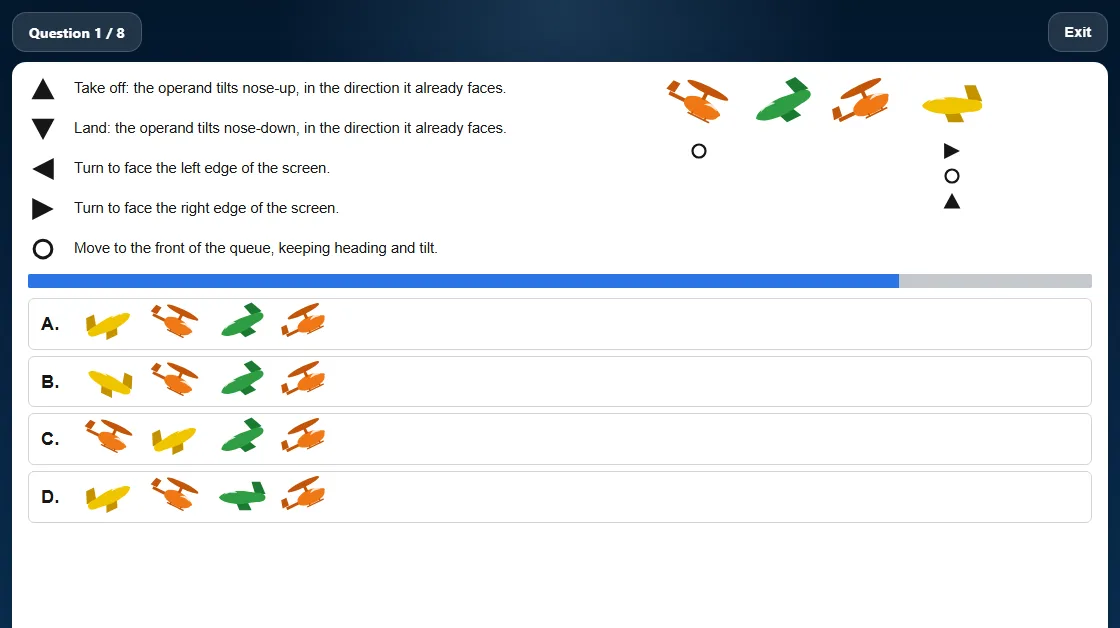
Coded Reasoning in the SureSelect Preparation Suite on this site. Independent practice, not an official SureSelect item.
A coded reasoning example, step by step
Start with three aircraft, all level: plane A faces right, helicopter B faces left, plane C faces right. Under A is one symbol, land. Under B are turn right, then take off. Under C are move to the front, then turn left.
- Plane A: land. A now points its nose down. It still faces right. The order is still A, B, C.
- Helicopter B: turn right. B now faces the right edge of the screen.
- Helicopter B: take off. B tilts its nose up, in the direction it now faces, which is right.
- Plane C: move to the front. C jumps to the left end. The order becomes C, A, B. C keeps its heading and tilt.
- Plane C: turn left. C now faces left. Nothing else changes.
The final row is C facing left and level, then A facing right with its nose down, then B facing right with its nose up. The wrong options in a question like this usually differ by exactly one thing: B still facing left, A still level, or C left in third place because the move was skipped.
In this short row the move came last, so it was easy to follow. In a row of five, a move halfway along shifts every aircraft to its left one place to the right, and the remaining symbols still belong to the aircraft they sat under, not to the position. Losing track of that is where most errors come from.
A method that holds up under time pressure
- Finish one aircraft before the next. Apply every symbol under it, top to bottom, then move right.
- Keep a running row. If scrap paper is allowed, write the order after each aircraft. The front is always the left end.
- Track three properties, not one. Every aircraft has a position, a facing and a tilt. Most wrong answers change only one of them.
- Carry the tilt through a move. An aircraft that takes off and then moves to the front arrives at the front with its nose up.
- Use colour as a label. In the practice module, two aircraft of the same colour are never neighbours in the question, so colour helps you keep two similar planes apart.
Mistakes that cost the most points
Two moves to the front. When two aircraft move, the one moved later ends up on the left. People who place the first mover at the front lose the whole question.
Turning towards the edge it already faces. Nothing happens. Candidates who flip the aircraft anyway pick the mirror image.
Waiting for feedback. In the practice module the next question appears at once and nothing tells you whether the last click was right. The only clock is a shrinking bar. Decide, click and move on.
Spending the first minutes learning the rules. Airways' academy FAQ says each test opens with a couple of practice questions you can repeat a few times. That is a short warm-up, not a tutorial. Arrive already knowing how a rule-application task feels.
Where coded reasoning fits in SureSelect
Coded reasoning is one test in a longer battery. The other modules, from detail accuracy to the radar simulation, are explained in what each SureSelect module measures, and the full selection sequence is in how to pass the SureSelect test. If a weak cognitive round has already cost you one application, read what happens if you fail SureSelect for the re-application rules.
The official description of the cognitive suite is on Airways International's SureSelect toolkit page. The practice version is in the SureSelect Preparation Suite.
Related Blog Posts
Qantas Group Pilot Academy Selection: Moodle Exam, Aon Cut-e Test and Interview
Flight Training Adelaide selects Qantas Group Pilot Academy students with a theory exam, a nine-module Aon cut-e assessment and a 90-minute interview in Toowoomba. Pass marks, fees and wait times from the 2026 guide.
IndiGo Cadet Pilot Program Selection: ADAPT Test, Group Task and Interview
IndiGo selects cadets through partner flight schools, starting with the Symbiotics ADAPT aptitude test and ending with an IndiGo group task and interview. Eligibility, the eight ADAPT tests and the attempt rules, by source.
Emirates Flight Training Academy Assessment: HireVue, Compass Test and Dubai Selection Days
Emirates Flight Training Academy screens international cadets online, then tests maths, physics and the Compass pilot aptitude battery in Dubai. Requirements, steps and fees as the academy published them.