

SureSelect Preparation Suite (2026): What Each Module Measures and How to Prepare

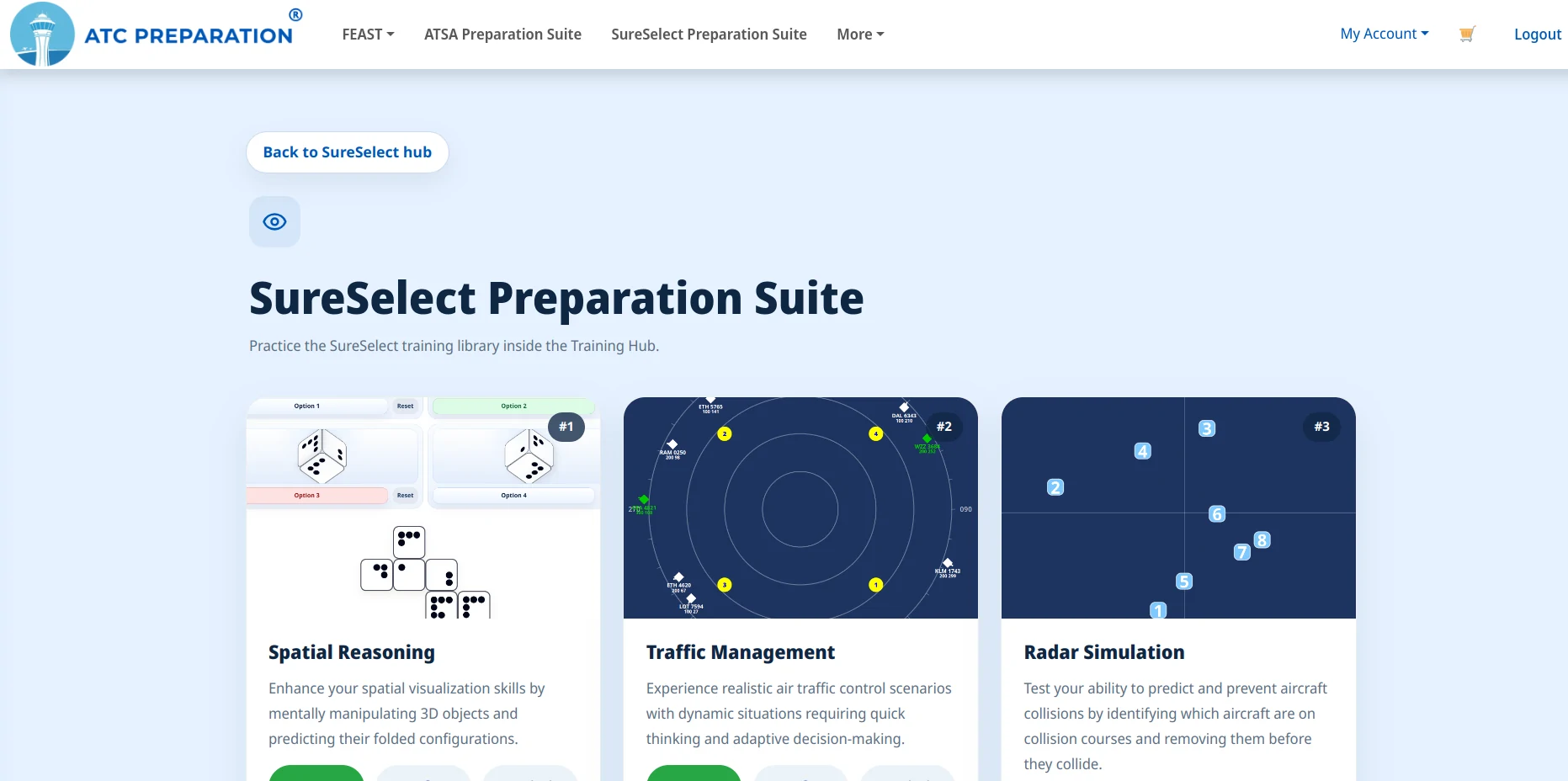
Independent practice overview. These screens are not official SureSelect items.
Last updated: September 11, 2026
Train with Preparation Software for SureSelect
Train spatial reasoning, memory, coded reasoning, radar simulation, and more in the SureSelect Preparation Suite with all difficulty levels, TEST mode, statistics, and candidate comparison.
SureSelect is not a single test with one published pass mark. Airways International sells it as a toolkit: employers pick which pieces to run, and candidates meet those pieces in sequence. If you only know the brand name, the toolkit still looks like a black box. If you read what Airways actually lists, the shape is fairly stable. The SureSelect Preparation Suite is independent practice mapped onto those families.
This article is the task-level map of the suite. For the hiring funnel, retakes, and a week-by-week plan, use How to Pass the SureSelect Test. For the country list and a first overview, start with the introduction to SureSelect. If Airservices Australia is your employer, the SHL cognitive guide covers the general aptitude stage that often sits in front of SureSelect.
Contents
How Airways groups the toolkit
The public SureSelect toolkit page and the 2026 brochure list the same three online families, plus an optional assessment centre that is not a browser puzzle. Durations below are Airways' published estimates for the full family, not a promise that your employer will run every item or use the same clock.
| Family | What Airways names | Published duration | Independent practice in our suite |
|---|---|---|---|
| ATC Cognitive Ability | Detail accuracy, coded reasoning | About 45 minutes | Detail Accuracy, Coded Reasoning |
| ATC Skill Simulations | Short-term memory, remembering relationships, spatial reasoning, radar simulation | About 1 hour 30 minutes | Short-term Memory, Remembering Relationships, Spatial Reasoning, Radar Simulation |
| Behavioural Traits | Decisiveness, emotional control, organised, take charge, learning focus | About 20 minutes | Behavioural Traits |
| Assessment Centre | Individual and group exercises, interviews | About 8 hours | Not a software module. Invitation-only, later in the process. |
Two notes before the task walkthrough. First, this is a map of skill families, not a leaked syllabus. Airways does not publish the test items or a single SureSelect-wide cut score. Scores are interpreted by the client using the results provided by SureSelect. Airways' privacy statement says candidate scores are ranked against an anonymised norm group, and the relative score is provided to the client. It also says the tests can involve any combination of short-term memory, spatial and verbal reasoning, cognitive ability, behavioural traits, and work preferences, and that the client's selected tests can vary. Second, employers configure the toolkit. Airways New Zealand is the reference stage-gate pattern in public articles. Other ANSPs may skip a family, change remote versus supervised delivery, or put a general aptitude test such as SHL in front. Follow the invitation.
Cognitive ability: check fast, then apply a rule
Airways describes this family as online cognitive work with high face validity: it should look like an ATC environment without being an operational shift. Public copy names two assessments. In Airways New Zealand's current stage-gate process, this is the first online screen, about 45 minutes, and the piece that removes a slice of the applicant pool before anyone reaches the simulations.
Cognitive ability
Detail Accuracy
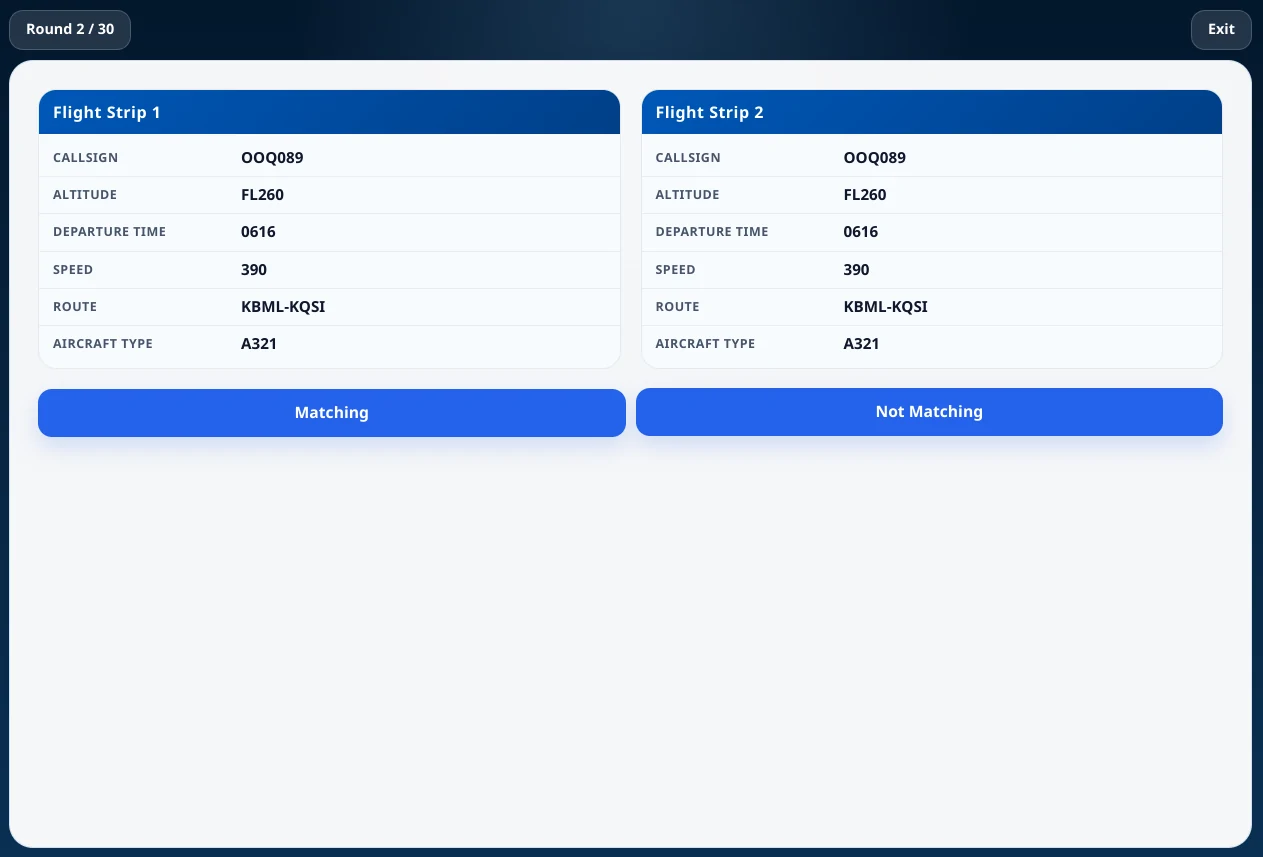
Airways' wording is blunt: quickly and accurately check a series of letters and numbers on a radar-style screen. The skill is visual comparison under a clock, not aviation knowledge. Our independent practice version of Detail Accuracy puts two flight strips side by side. You decide whether every field matches or exactly one field differs. Higher levels add fields and shrink the window. TEST mode removes the pause between rounds.
The usual miss is a random scan. Pick a field order and keep it. Speed comes after the pattern is stable. You can try a reduced browser version on free SureSelect training before unlocking the full difficulty curve.
Cognitive ability
Coded Reasoning
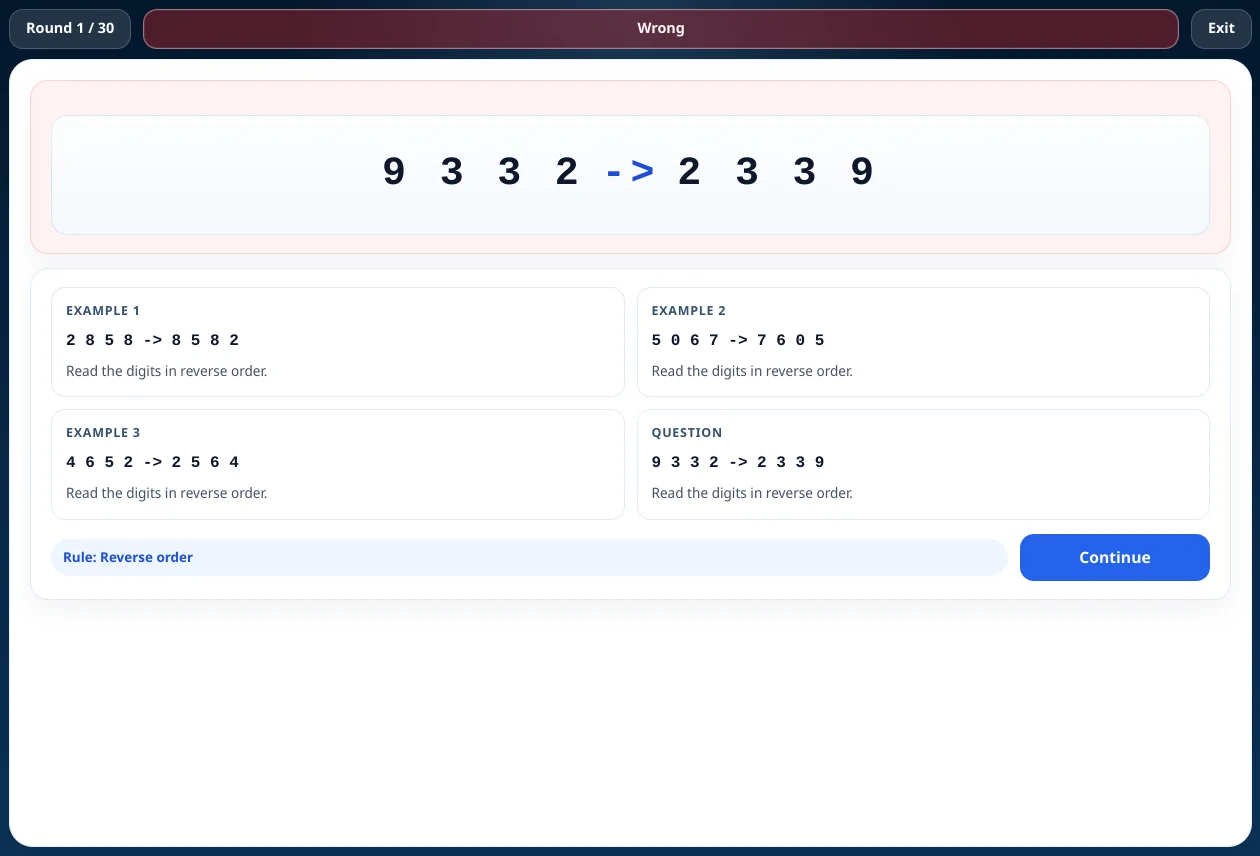
Airways describes coded reasoning as applying a set of coded rules to an aviation scenario. The underlying demand is rule inference: see examples, extract one consistent transformation, execute it on a new input. Our independent practice version of Coded Reasoning shows three example transformations, then asks you to type the output for a question sequence. Rules can reverse digits, shift positions, add or subtract, or combine those ideas. Guessing from one example fails when the third example contradicts the first guess. Hold the rule in working memory and check it against every example before you type.
Skill simulations: memory, space, and a moving picture
The toolkit lists four gamified assessments and about ninety minutes for the family. Airways' reason for this block is that traditional psychometrics struggle to measure some controller skills, so the tasks are built to look more like the job. They are still psychometric drills. Looking like radar does not make you a controller, and treating them as a game you can brute-force usually produces messy scanning.
Skill simulations
Short-term Memory
Encode, then recall after the display disappears. Our independent practice version of Short-term Memory alternates character sequences with short aircraft lists (callsign, flight level, heading). Questions ask for the full sequence, one character, a flight level, or a heading. Encoding time shrinks as levels rise. The failure mode is trying to remember everything with equal weight. Chunk the sequence. For aircraft cards, bind the requested fields to the callsign instead of rereading the whole table from scratch when the question appears.
Skill simulations
Remembering Relationships
This is relational memory, not a digit span. You hold who is left of whom, who is higher, who is heading where, then answer after the list vanishes. Our independent practice version of Remembering Relationships builds a small aircraft map, then asks multiple-choice questions, including combined altitude-and-heading conditions on later levels. Draw a quick mental sketch during the intro. Verbal rehearsal of isolated sentences falls apart once attributes combine. A lighter browser version sits at the end of the free SureSelect route.
Skill simulations
Spatial Reasoning
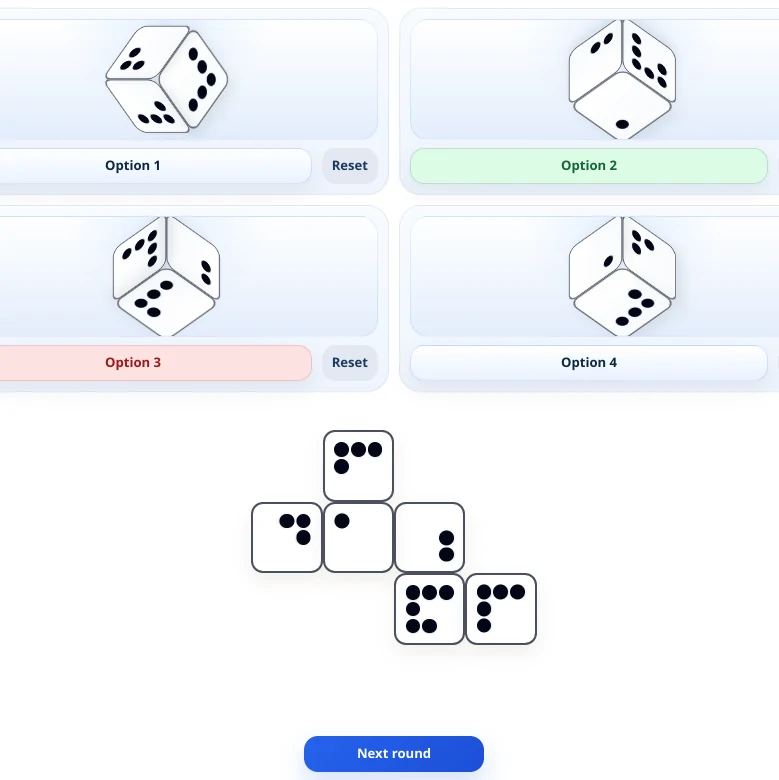
Airways identifies spatial reasoning as one of the ATC Skill Simulations. Our independent practice version of Spatial Reasoning uses cube-folding tasks: study an unfolded net, then pick the 3D cube that keeps the same adjacency, opposites, and orientation. Later levels add a "none of these" option and more distractors. Eliminate impossible neighbour or opposite pairs before you rotate the remaining cubes in your head.
This is one of the two email-free previews on free SureSelect training. Use it to learn the comparison method. Do not treat an easy score as evidence you are done.
Skill simulations
Radar Simulation
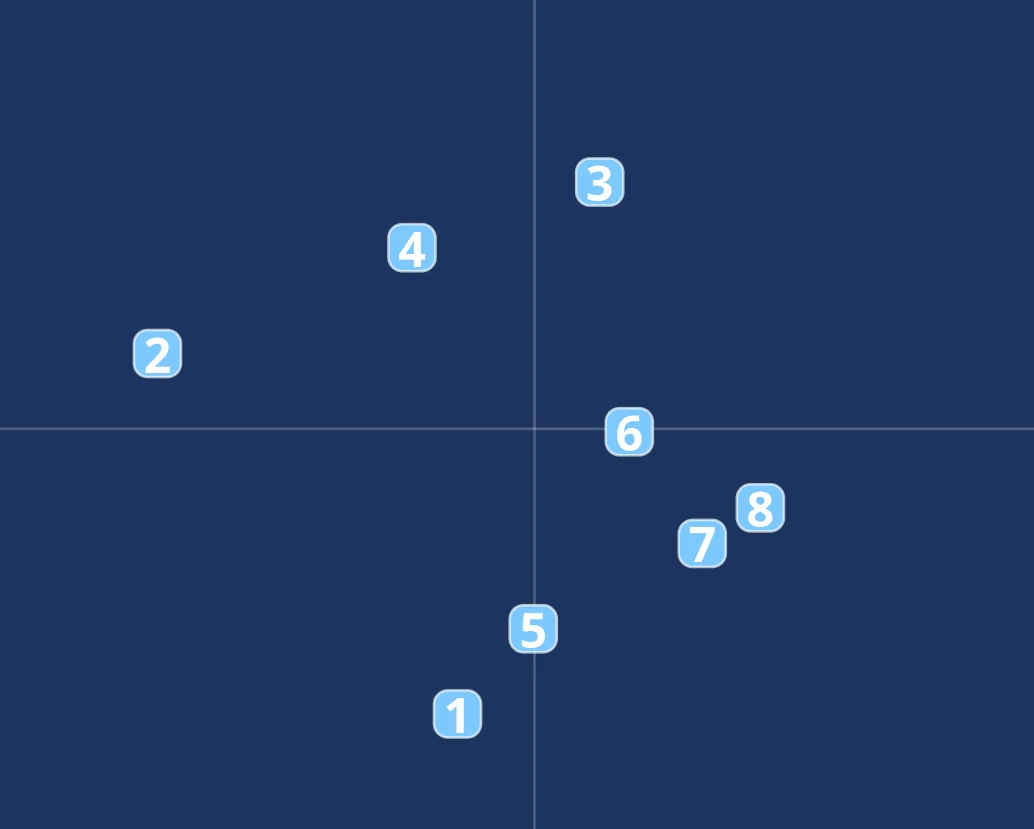
Airways tags radar simulation with safety, efficiency, and multi-tasking. That is a family description, not a screenshot of their item. Our independent Radar Simulation practice focuses on conflict prediction: numbered aircraft move in straight lines, and you remove a collision pair before contact, or press 0 if nothing will hit. Later levels add a secondary math prompt. Watch trajectories, not current proximity. Removing a safe aircraft is an error. Waiting until two targets already overlap is also an error. This is a training exercise, not live operations.
Behavioural traits: consistency, not a personality costume
Airways publishes this as a short questionnaire, about 20 minutes, measuring traits they treat as predictive of ATC success: decisiveness, emotional control, organisation, taking charge, and learning focus. In the January 2026 Airports International feature, Airways staff talking about their own process also mention rule adherence, accuracy focus, and fast decisions. The point for candidates is simpler. This round is scored as a profile, not as puzzles you can grind.
Behavioural traits
Behavioural Traits
Our independent practice version of Behavioural Traits is questionnaire practice: one workplace statement at a time, rated from Strongly Disagree to Strongly Agree. After each stopped round you see the category and an explanation so the rhythm of the format is familiar. On the final level the pause between items goes away.
Use it to learn pacing and to notice when you contradict yourself. Do not memorise items. They will not appear on test day. Extreme "what they want to hear" answers on every statement tend to look fake. Answer as you would behave in a safety-critical workplace, then stay consistent when similar statements return in different wording.
Practice we add on purpose
The suite has nine modules. Airways' published online toolkit names seven assessments across the three families above. The two extras are independent training, labelled that way on purpose.
Independent extra (not named as a separate toolkit test)
Traffic Management
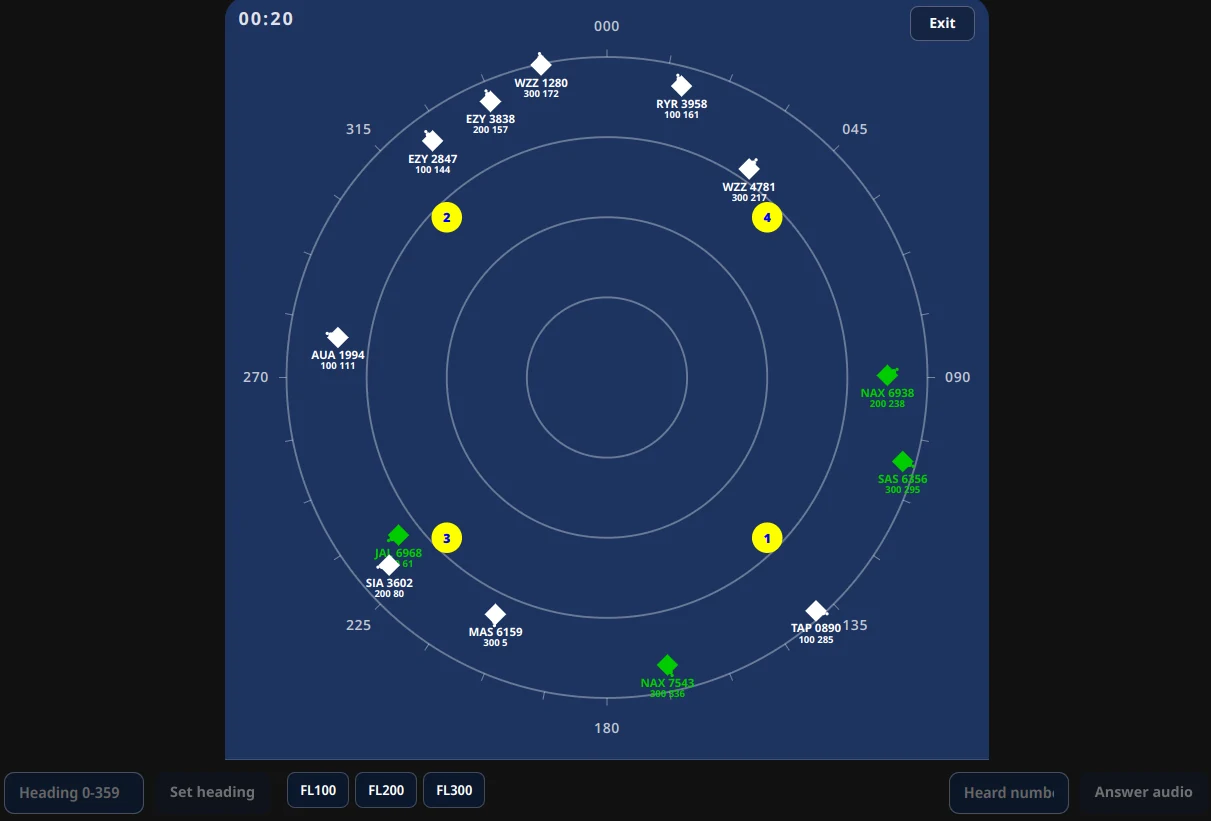
Traffic Management is an independent control task: select aircraft, set headings and altitudes, send them through waypoints, keep separation, and answer spoken numbers when audio is on. Airways' radar simulation is listed as one skill-simulation assessment covering safety, efficiency, and multi-tasking. We keep collision prediction and live control as two practice surfaces because they fail for different reasons. Prediction errors are trajectory misreads. Control errors are late heading changes, ignored decoys, or dumped audio. Do not assume your employer will present this exact interface.
Independent extra (not in the published toolkit list)
Reading Comprehension
Airways does not list a standalone reading test in the public toolkit. Controllers still read strips, clearances, and instructions under time. Our independent practice version of Reading Comprehension is timed passage work: answer from the text, not from outside knowledge. Treat it as verbal precision training. Skip it if your invitation clearly contains only the named families and your time is short. Keep it if careless reading is already showing up in coded reasoning or strip comparison.
A sensible training order
Do not start with the busiest radar screen because it looks like the job. Start with the two cognitive tasks. In Airways New Zealand's current stage-gate process they are the first online screen, and they expose whether you can keep accuracy when the clock is short. Then add one memory task and spatial reasoning. Put radar work after those four are no longer chaotic. Leave behavioural practice for a short block near the end, once a week, not as daily grinding.
Inside the SureSelect Preparation Suite, use easy levels to learn the method, then TEST mode to see your pacing against other candidates. Scores in our software are feedback for practice. They are not an employer cut score. If you want a calendar rather than a task map, the plan in How to Pass the SureSelect Test is the companion piece.
One rule that applies to every family: train the full set your invitation names. There is no published SureSelect-wide cut score. The client interprets the results SureSelect provides. Banking everything on spatial ability while detail accuracy collapses is still a bad bet.
FAQ
What tasks are in the SureSelect test?
Airways publishes three online families: cognitive ability (detail accuracy and coded reasoning), skill simulations (short-term memory, remembering relationships, spatial reasoning, radar simulation), and a behavioural traits questionnaire. An assessment centre, if used, is a later supervised day, not another browser module. Your employer chooses the mix. Airways' privacy statement also notes that the tests can involve any combination of those skill areas, and that the client's selected tests can vary.
Are these practice modules the official test?
No. They are independent tasks mapped to the skill families in Airways' public toolkit. We do not reproduce confidential items, and Airways does not endorse this product.
Does every ANSP use the full toolkit?
No. Public Airways material is clear that customers configure the toolkit. Australia, New Zealand, and other listed markets can differ on remote versus supervised delivery and on what sits in front of SureSelect. Read the vacancy, not a generic forum post.
Should I train behavioural traits like a cognitive module?
No. Cognitive and simulation work reward clean method under time. The questionnaire rewards a consistent work-style profile. If you try to game every item toward an imagined ideal controller, similar statements will catch the contradiction.
What can I try without paying?
Free SureSelect training currently opens Spatial Reasoning and Detail Accuracy without an email session, then a short set of other previews after signup. Coded reasoning, traffic management, and radar simulation stay in the paid library.
Related Blog Posts
Transavia Pilot Aptitude Test: Compass and CPP Guide
Transavia uses Compass, the EPST aptitude battery, and CPP, the Checklist Professional Profile. Direct-entry first officers and Airline Pilot Program applicants then follow different selection stages.

Ryanair Pilot Aptitude Test: A Guide to Aon and cut-e
Ryanair asks applicants to complete an online Aon aptitude test, still called cut-e, before the simulator. The process depends on whether you apply direct with a Ryanair Group airline or through the Future Flyer Academy.
Free FEAST Training: How to Prepare for FEAST I and FEAST II
Free FEAST training for FEAST I and a first look at FEAST II: which modules are included, how to start, and when the Easy level stops being enough.