

What Skills Do You Need to Be an Air Traffic Controller?


Istanbul Airport. Hiring tests sit at the start of the process, before ATC training.
Last updated: September 12, 2026
ATC selection tests check how you work under time pressure. FEAST, ATSA, SureSelect and NATS selection tests assess a range of cognitive and other abilities, although the exact skills and modules vary by test. You do not need ATC procedures before you sit them. Training covers that later.
Below is what the employers actually list, plus what practice can help with. For the hiring path, start with how to become an air traffic controller. For a shift, see a day in the life.
Contents
Selection tests and the job
The tests use some of the same skills as the job. Passing them still leaves training, medical, and a unit validation ahead of you.
Each battery is different. EUROCONTROL built FEAST around cognitive tests, English, work-sample multitasking, and often a personality questionnaire. The FAA describes ATSA as a 3.5-hour aptitude exam. NATS Stage 1 is eleven timed ability tests. You do not need ATC procedures for any of these.
Training then covers procedures, airspace, phraseology, strips, and working with the next sector. Shift work is part of the job as well. ICAO describes situational awareness as watching what matters, keeping a picture, and thinking ahead. The tests cover some of that. They will not tell you how you cope with nights or early starts.
EUROCONTROL says this on the candidate site. You do not need an aviation background for FEAST. For interviews and later stages, it helps to know what the job involves.
Cognitive skills employers actually name
FEAST, NATS, DFS, ATSA, and SureSelect do not use the same labels. The list below is based on their public material.
Spatial orientation and a sense of direction
Controllers need to keep track of where aircraft are relative to each other, including left and right when the view is rotated, and whether two tracks are likely to cross. EUROCONTROL lists spatial orientation in FEAST I. NATS names spatial awareness and sense of direction in Stage 1. DFS lists good spatial awareness among personal strengths. A flight simulator does not replace this. The test items are about orientation and relative position under a timer.
Hong Kong International Airport. Spatial items are timed questions about position and direction.
Working memory
A clearance can include a callsign, a level, a heading, and a constraint. You have to hold that information while the next transmission comes in. FEAST I measures memory. NAV CANADA lists a good memory among the qualities it values. SureSelect's public toolkit names short-term memory and remembering relationships as skill simulations. It gets harder when something else is happening at the same time.
Divided attention and multitasking
FEAST II includes work-sample exercises designed to assess abilities relevant to handling multiple tasks. RADAR and MULTI-PASS are work samples for beginners. They are not operational training. On a live position that often means watching the display, listening to the frequency, and updating strips.
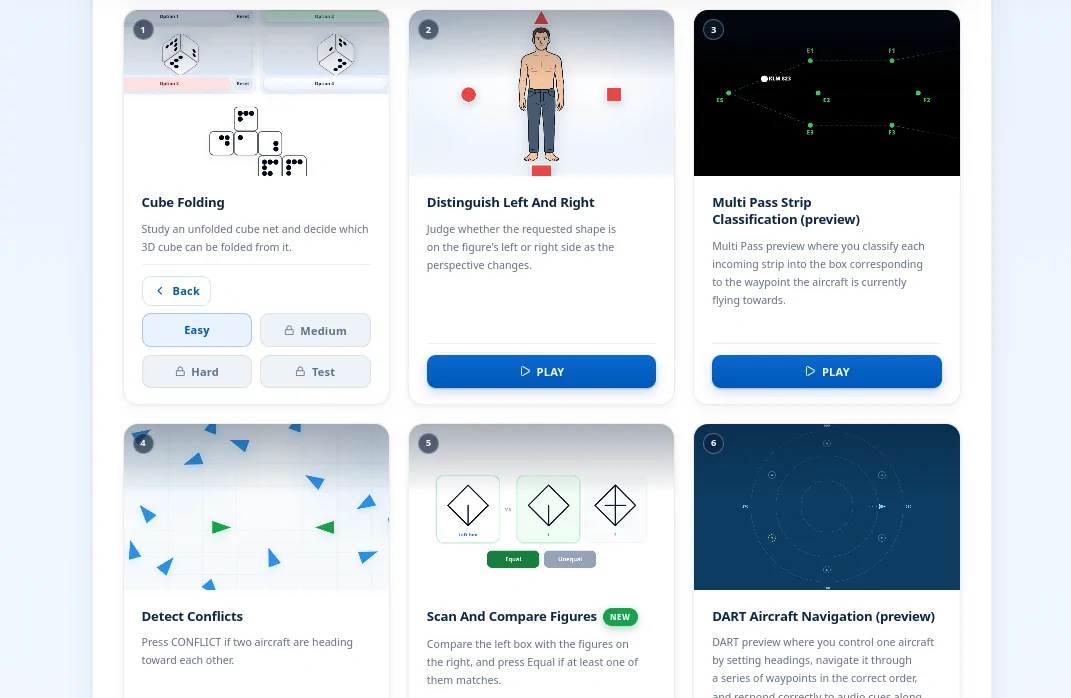
If you want to try this kind of task, start with divided attention and the free training hub. Those modules are independent practice, not official test items.
Visual perception, scanning, and detail
FEAST I includes visual perception, attention, and perceptual speed. SureSelect names detail accuracy: checking characters and numbers quickly. On the job this shows up as noticing a wrong level, a conflicting strip, or an aircraft that is no longer doing what you expected. If you scan in a fixed order, you miss fewer items when the timer gets short.
Logical reasoning, planning, and numbers
EUROCONTROL lists decision-making, planning ability, and logical reasoning. NATS lists logical thinking and numerical ability. Mental arithmetic shows up in FEAST and in several national batteries because levels, speeds, and time-to-conflict are numbers. The sums are usually simple. You still have to get them right with a timer running.
Decision speed
DFS wants people who can decide quickly under pressure. NAV CANADA lists decision-making next to problem-solving. NATS measures reaction speed, then re-runs those tests in the assessment centre while you are observed.
| Skill | Who names it in public material | Where it shows up |
|---|---|---|
| Spatial orientation / sense of direction | EUROCONTROL, NATS, DFS | FEAST I, NATS Stage 1, later radar work |
| Working memory | EUROCONTROL, NAV CANADA, Airways (SureSelect) | FEAST I, SureSelect skill simulations |
| Multitasking / divided attention | EUROCONTROL, FAA (ATSA as a skills exam) | FEAST II RADAR and MULTI-PASS |
| Visual perception and detail | EUROCONTROL, Airways (detail accuracy) | FEAST I, SureSelect cognitive family |
| Logical / numerical reasoning | EUROCONTROL, NATS | FEAST I, NATS Stage 1 |
| English listening and speaking | EUROCONTROL, EASA, DFS, NATS, NAV CANADA, FAA | FEAST English test, NATS listening, licence endorsement |
| Stress tolerance / emotional control | EUROCONTROL (interview), DFS, NAV CANADA, Airways behavioural traits | Interview, personality questionnaire, assessment centre |
English, listening, and the radio
ICAO operational level 4 is the EASA minimum for exercising a student or controller licence in English. Level 4 is valid for three years, level 5 for six, and English at expert level 6 for nine years. Many units also require the local language used on frequency. DFS currently asks for English and German at C1 before training. NAV CANADA requires fluent English, and English plus French in the Montreal FIR.
Selection tests usually check listening and comprehension, not a full ICAO oral exam. FEAST includes an English language listening and comprehension test (ELICIT). NATS Stage 2 includes a listening comprehension test. The FAA requires English clear enough to be understood over communications equipment.
On frequency you need to read back what was actually said, keep transmissions short, and stay understandable when the other speaker is not a native English speaker. EUROCONTROL Maastricht interviews also score interactive proficiency separately from the computer English test.
Work style and personality questionnaires
Some FEAST users also administer FEAST III, a personality questionnaire, about 35-45 minutes. EUROCONTROL's candidate text is clear: there are no right or wrong answers, and you should not spend a long time on each item. Airways names decisiveness, emotional control, organisation, taking charge, and learning focus in the SureSelect behavioural family. NAV CANADA lists resilience under pressure and high motivation. DFS wants concentration, a cool head, and a sense of the consequences of your actions.
Maastricht's interview panel (active controllers, psychologists, training and HR) looks at motivation, education and work history, knowledge of the job, stress resistance, personality, and interactive proficiency. That stage is about job fit.
Do not try to sound like a perfect controller. Similar statements come back in different wording, so inconsistent answers show. Answer the way you would at work. For format practice only, see ATSA personality profiling. Do not memorise items.
What you do not need
- An aviation degree, a PPL, or VATSIM hours. EUROCONTROL, NATS, NAV CANADA, and the FAA all say prior ATC knowledge is not required for the tests or for trainee hiring. EUROCONTROL also says virtual ATC or flight simulators are not required for FEAST.
- A photographic memory. The tests look at short-term memory while other information is still coming in.
- Being the most talkative person in the room. Assessment centres look for clear communication. Talking over everyone, or saying nothing, both look bad.
- Perfect uncorrected vision. DFS states that glasses or contacts are acceptable within +5/-6 dioptres. Medical standards differ by authority. EASA Class 3 standards allow correction within specified limits, while FAA ATCS applicants must meet the FAA's separate vision, colour-vision and hearing requirements. An aero-medical examiner decides.
- A hobby in aviation. Interest in the job helps at interview. It will not raise a FEAST score by itself.
What practice helps with
Practice can make you faster and more accurate on the kinds of tasks used in selection.
Improves with practice
- Scan order on comparison and radar-style screens
- Chunking for short-term memory items
- Cube nets, headings, left/right under rotation
- Simple arithmetic at speed
- English listening with ATC-like density
- Switching between two tasks without dropping either
Harder to drill
- How you recover after a mistake
- Whether your questionnaire answers stay consistent
- Whether you can stay concentrated through a 2.5-4 hour FEAST I session
- Whether shift work and relocation are acceptable to you
- Whether you actually want the job, which interviews do check
If you want a quick check before you apply, try a timed dual task and a spatial task. If a second task makes your accuracy drop a lot, take that seriously. If you already have an invitation, train the tests that employer actually uses.
- Europe / NAV CANADA: How to pass FEAST · FEAST modules explained
- United States: How to pass ATSA · ATSA modules
- SureSelect users: SureSelect module map
EUROCONTROL has a free training platform and says third-party products were built without its involvement. Our software is independent practice for the same skill families.
FAQ
What skills do you need to be an air traffic controller?
Most employers look for spatial orientation, working memory, divided attention, visual scanning, decision speed, and operational English. FEAST also lists planning and logical reasoning. NATS adds numerical ability, sense of direction, reaction speed, listening, and situational judgement. NAV CANADA and DFS both put stress tolerance on the list. Procedures are taught in training.
Do I need aviation knowledge to pass the tests?
No. EUROCONTROL, the FAA, NATS, and NAV CANADA all hire trainees without an ATC background. Interviews still expect you to know what the job involves.
Can these skills be trained?
You can get used to the formats and improve timing and accuracy on the computer tests. Personality questionnaires and whether you want shift work are separate. Practice will not get you through medical, interview, or a training place on its own.
Is a good memory enough?
No. Memory is only one of the things these tests measure. If spatial tasks or divided attention are weak, a strong memory score usually is not enough.
Related Blog Posts
Transavia Pilot Aptitude Test: Compass and CPP Guide
Transavia uses Compass, the EPST aptitude battery, and CPP, the Checklist Professional Profile. Direct-entry first officers and Airline Pilot Program applicants then follow different selection stages.

Ryanair Pilot Aptitude Test: A Guide to Aon and cut-e
Ryanair asks applicants to complete an online Aon aptitude test, still called cut-e, before the simulator. The process depends on whether you apply direct with a Ryanair Group airline or through the Future Flyer Academy.
Free FEAST Training: How to Prepare for FEAST I and FEAST II
Free FEAST training for FEAST I and a first look at FEAST II: which modules are included, how to start, and when the Easy level stops being enough.