ATSA Personality Profiling: What It Is, How to Prepare & Common Mistakes (2026)


Train with Simulator Software for ATSA
Work through forced-choice personality blocks in ATSA Personality Test Preparation, then pair it with the ATSA Preparation Suite for the cognitive modules.
Most ATSA preparation time goes to collision judgment, memory blocks, and reading speed. That makes sense until you reach the personality and biographical section and realise you have never worked through a forced-choice profiling block under exam conditions.
Pearson VUE describes the ATSA as a multi-subtest aptitude assessment covering decision-making, spatial awareness, multitasking, and working memory, among other skills. Public FAA and Pearson materials do not publish a separate study guide for the personality or biographical component. Candidates still report a scored profiling section inside the same sitting, and treating it as filler is a common reason otherwise prepared applicants lose composure late in a long test day.
This guide focuses on that profiling portion: what it is trying to measure, how forced-choice formats behave, and where independent practice helps without pretending the FAA endorses it. For cognitive modules and hiring logistics, see our FAA ATSA Test Guide and How to Pass the ATSA Test.
Last updated: August 3, 2026
Scope note: Item counts, section order, and exact question layouts can change between hiring cycles. Where the FAA and Pearson VUE stay silent, this article describes patterns widely reported by candidates and used in independent practice tools. Your Authorization to Test email and USAJobs announcement override anything here.
What the FAA publishes vs. what candidates sit through
The Pearson VUE FAA page states that nearly 3.5 hours are allotted for the ATSA, including up to 2 hours 49 minutes of testing plus break time. On preparation, Pearson is direct: the ATSA is an aptitude assessment, no studying is necessary, and the FAA does not endorse practice tests.
That official line covers the whole appointment. It does not spell out how many items sit in the personality or biographical block, whether it uses pairs or triads, or how much weight it carries inside your final category. Candidates who have completed the ATSA in recent cycles routinely describe a separate profiling section with a large bank of forced-choice statements about work style, stress, rules, and cooperation. Treat those reports as field knowledge, not as a leaked blueprint.
| Cognitive subtests (publicly named by Pearson VUE) | Personality / biographical profiling (candidate-reported) |
|---|---|
| Decision-making, spatial awareness, multitasking, working memory | Forced-choice statements about preferences and behaviour under pressure |
| Timed modules with objectively scored responses | No single "correct" answer; consistency across related items matters |
| Where most third-party prep tools focus | Often under-practised until test day |
| Covered in our ATSA modules guide | Covered in our ATSA Personality Test Preparation |
Forced-choice profiling in plain terms
A forced-choice block presents several statements at once and requires you to rank or select among them: which is most like you, which is least, sometimes leaving the middle option neutral. You are not agreeing or disagreeing on a five-point scale. You are committing to relative preferences even when two statements both feel partly true.
That design makes sense for controller selection. Radar work rarely offers a perfect option. You choose the least bad path under time pressure and stay consistent with procedures while coordinating with others. A profiling section built on trade-offs mirrors that decision pattern more closely than a simple agree/disagree survey.
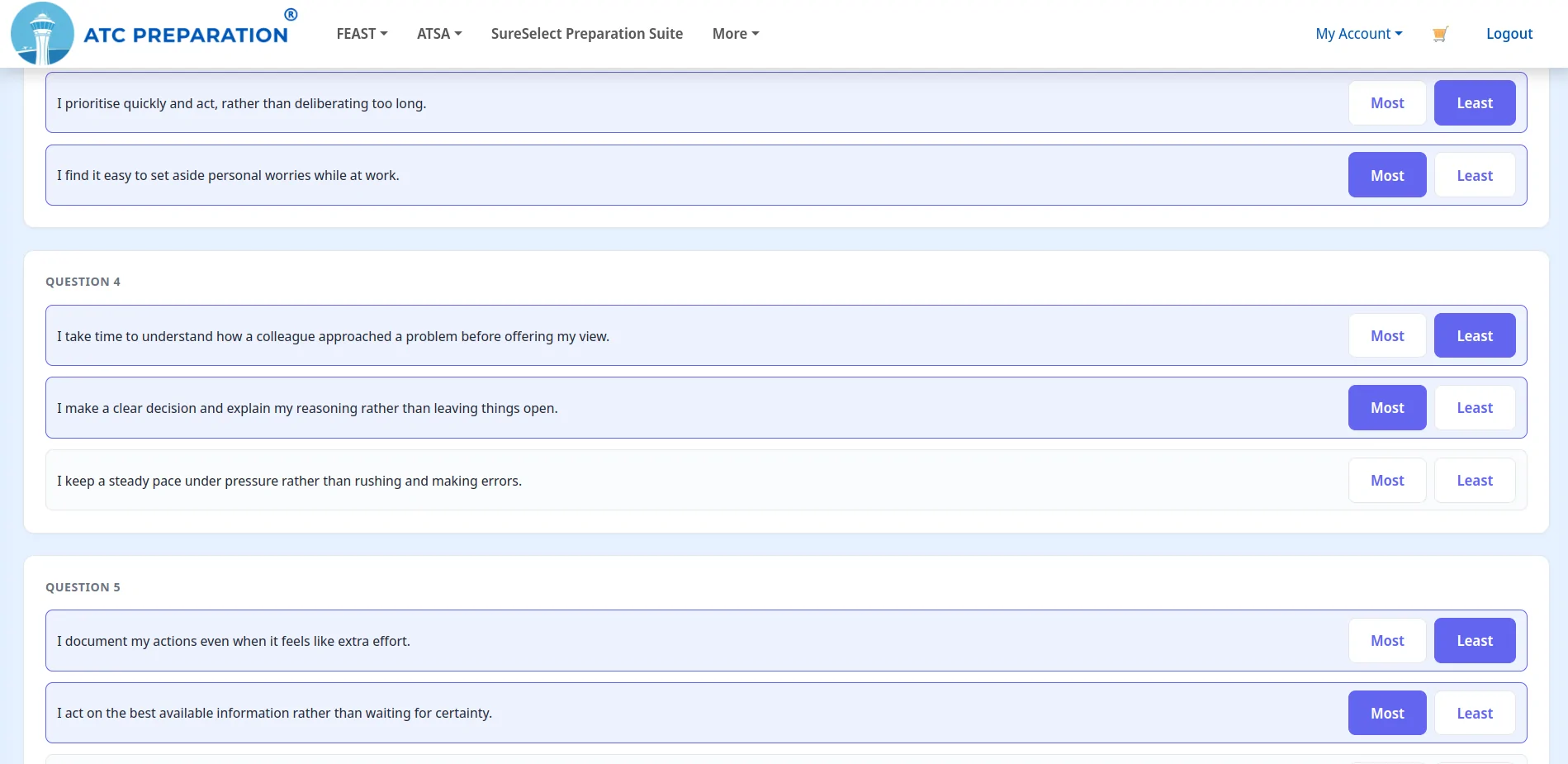
Candidate reports often place this section late in the session, after cognitive fatigue has already accumulated. If every prior module was timed and objective, switching into self-description mode feels unfamiliar. A few untimed practice runs before test day removes the format shock even when the FAA says no study is required.
Behavioural dimensions the FAA screens for
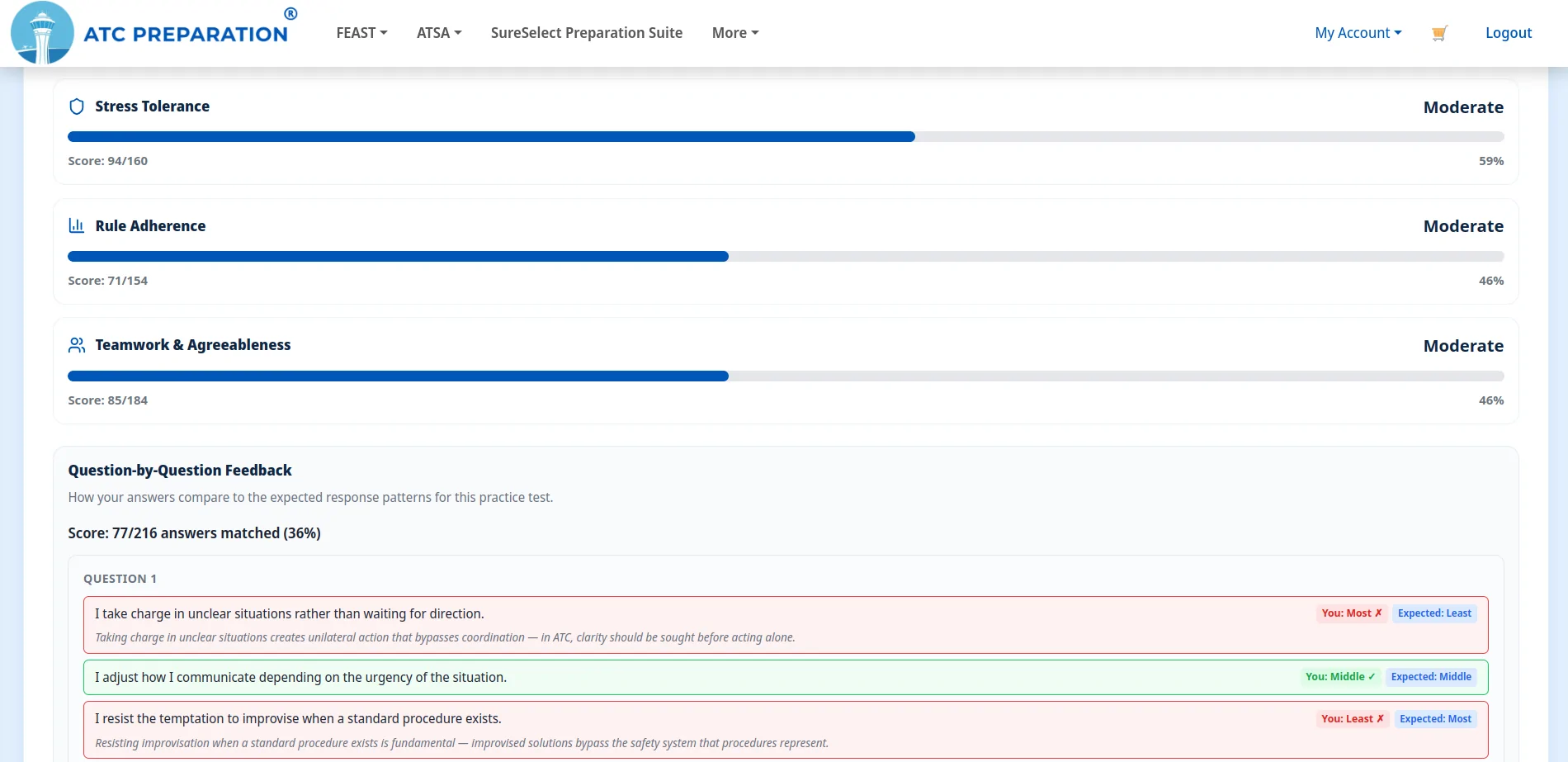
The FAA does not publish a dimension chart for the ATSA personality block. Independent preparation tools and hiring literature converge on four clusters that map to day-one controller work. Our personality practice groups feedback along the same lines.
Decisiveness
Controllers commit to clearances and corrections without indefinite hesitation. Profiling items in this area probe whether you default to action, delay for more data, or defer when ownership is ambiguous. Extreme profiles in either direction can raise flags: permanent hesitation under load, or impulsive calls without checking constraints.
Stress tolerance
Traffic volume spikes, equipment quirks, and non-standard requests arrive in the same shift. Items here ask how you describe your reactions to sustained pressure, criticism, and workload swings. The goal is not to claim immunity to stress. It is to show a stable, professional pattern that matches how you respond on cognitive sections later in the same sitting.
Rule adherence
Aviation runs on procedures that exist because ambiguity kills margin. Statements may contrast strict protocol following with improvising when rules feel inconvenient. Controllers need both rule discipline and judgment; profiling looks for whether your self-report matches someone who treats procedures as baseline, not obstacle.
Teamwork
Floor coordination, handoffs, and briefings depend on people who communicate directly and recover after friction. Items touch preference for solo ownership vs. shared problem-solving, response to peer disagreement, and willingness to escalate. Tower and en route environments are team sports even when you stare at your own scope for hours.
Consistency is the scoring logic
Personality profiling in federal hiring is not a trivia section. There is nothing to memorise and no answer key to download. Scoring models look for stable self-report patterns across items that measure the same underlying trait from different angles.
Candidates who try to reverse-engineer a heroic controller persona often contradict themselves ten items later: high rule adherence here, flexible improvisation there, extreme stress immunity in one block and frequent overwhelm in another. Research on biodata and personality inventories in occupational selection consistently finds that inconsistent profiles underperform honest, stable ones in predicting tenure and performance. The FAA has not published its internal weights, but the practical advice survives independent of vendor: answer in a voice you can maintain for a hundred consecutive items.
Pace matters as well. Third-party guides suggest moving steadily through profiling sections rather than overthinking each triad. Long pauses invite revision, and revision invites contradiction. Read the set once, mark most and least, move on. If two statements both feel true, pick the stronger fit and accept imperfection.
Mistakes that show up late in the session
Skipping format exposure entirely. Cognitive drills do not transfer to forced-choice triads. Candidates who only run collision sims enter the profiling block cold and burn mental energy decoding instructions instead of answering.
Building a fictional controller character. Inventing answers you think the FAA wants produces cross-item conflicts. Your application, interview behaviour, and later MMPI-2 evaluation in the hiring pipeline are all part of the same story. Profiling is one chapter, not a standalone audition.
Answering socially desirable instead of accurately. Always agreeing with teamwork statements and never admitting frustration reads as flat. Real profiles have shape. Extreme uniformity looks coached.
Treating profiling as unscored filler. You receive one hiring category for the whole ATSA, not separate grades per module. A weak or inconsistent profiling performance still sits inside that composite outcome alongside cognitive results.
Practising with feedback you treat as official. Third-party dimension scores show how your practice profile looks relative to training benchmarks. They cannot tell you whether you will land in Well Qualified. Category placement depends on the applicant pool that cycle.
Where practice actually helps
The FAA tells you to sleep, eat, and arrive on time. That remains the baseline. Independent personality practice fills a narrower gap: learning the forced-choice rhythm, discovering which dimensions feel automatic vs. awkward, and finishing a full-length block once without quitting halfway from boredom.
Our ATSA Personality Test Preparation runs 108 three-statement items across Decisiveness, Stress Tolerance, Rule Adherence, and Teamwork, with saved attempts and dimension feedback. It is untimed deliberately; the official section may be timed, but accuracy and consistency come first when you are learning the format. It is sold separately from the ATSA Preparation Suite, which covers the cognitive modules. Pair both if you want full ATSA coverage before test day.
If you already hold a Qualified result and wonder whether retesting makes sense, read what happens after a weak ATSA outcome before you schedule another sitting. A new attempt replaces your prior category permanently.
Questions candidates ask
Is the personality section separate from the cognitive ATSA?
Candidates report both inside one Pearson VUE appointment that spans roughly three hours with breaks. Think of it as one hiring exam with multiple subtests, not a standalone personality test you schedule on your own.
Should I prepare differently from cognitive modules?
Yes. Cognitive prep builds speed and accuracy on repeatable task types. Personality prep builds familiarity with forced-choice trade-offs and surfaces contradictions in how you describe yourself. Cramming the night before helps neither; one or two calm practice sessions a week before your appointment is enough for format exposure.
Does honesty mean answering without thinking?
Honesty means stable thinking, not speed for its own sake. Consider each triad, pick the relative best fit, and keep the same professional baseline you would show in a structured interview. Changing your implied personality every few items is what scoring systems penalise.
Related Blog Posts

How to Become an Air Traffic Controller (2026 Guide)
How to become an air traffic controller in 2026: eligibility, age limits, selection tests, and train...
Read More
What Skills Do You Need to Be an Air Traffic Controller?
The skills air traffic controller selection actually measures: spatial awareness, working memory, mu...
Read More
SureSelect Preparation Suite (2026): What Each Module Measures and How to Prepare
What each SureSelect Preparation Suite module trains: cognitive ability, ATC skill simulations, and ...
Read More