NATS Test Explained: The Complete Guide (2026)


NATS logo. Shown for identification only.
Last updated: September 30, 2026
What is NATS?
NATS provides air traffic control for aircraft in UK airspace, and for flights crossing the eastern part of the North Atlantic. It handles over two million flights a year. A trainee application is an application to do that work. You do not need previous aviation knowledge or flight experience.
The job splits in two. En route controllers work from two centres. Swanwick, in Hampshire, looks after the southern half of UK airspace. Prestwick, in Ayrshire, looks after the north, including Scottish airspace and the transatlantic flights as they enter or leave UK airspace. Tower controllers work at the airports, looking after movements on the ground, the take-off, and the landing.
What is the NATS test?
Applying as a trainee air traffic controller means a four-stage selection process. It is demanding, and it is also knowable: each stage has a set job, and you have to pass it before you are invited to the next. The stages are:
- Stage 1: Online ability tests
- Stage 2: Situational judgement and listening
- Stage 3: Virtual assessment centre
- Stage 4: Practical exercise
Each stage is a filter. Pass one, then you move on.
Stage 1: online ability tests
Stage 1 is done online from home. NATS uses Aon to run it. Aon is an assessment company that builds online ability tests for employers and delivers them in the browser. For this stage that is eleven short cognitive tests. The session is supervised remotely, through your webcam and microphone.
The tests are gamified, fast, and strictly timed. Aon scores both accuracy and reaction speed while the clock is running. The formats change from one short module to the next. A few of them:
- Monitoring Ability checks how quickly and accurately you track several moving objects.
- Motion Challenge asks you to move objects through grid mazes in as few moves as you can.
- Grid Challenge asks you to recall positions and symbols while the layout keeps changing. That is working memory and visual attention.
Other modules cover the rest of the cognitive set. Because the task changes each time, read the instructions before every test. The point of the stage is how fast and how accurately you handle information under time pressure. Your combined result across all eleven decides whether you go to Stage 2.
Stage 2: situational judgement and listening
Stage 2 measures something else. You complete two more online assessments, again supervised remotely.
The first is a situational judgement test. You get realistic workplace scenarios and judge which responses fit. It looks at judgement, communication, teamwork, and decision-making in a safety-critical job.
The second is a listening comprehension test. You hear recorded information and answer from what you heard. It checks how accurately you take in and keep spoken detail under pressure.
Together they cover practical judgement, attention to detail, and decisions made from what you have just heard.
Stage 3: virtual assessment centre
Stage 3 is virtual, and several assessments sit in one session. You do a competency-based interview, an air traffic control knowledge test based on the preparation material NATS provides, and an observed retest of some of the cognitive assessments.
The interview is about the behaviours the role asks for: communication, teamwork, motivation, and decision-making. Pass Stage 3 and you are invited to the practical exercise.
Stage 4: practical exercise
Stage 4 is in Whiteley, Hampshire, at NATS headquarters. It is the only part of selection done in person, and the closest the process gets to the job.
You work through several short simulations, managing aircraft in a realistic setting, and you explain your decisions out loud. After each scenario the assessors give feedback, then you move to the next. They are looking at situational awareness, communication, decision-making, and whether you learn and adjust as the session goes on. Those scenarios are a short version of the work at the centres and in the towers.
How to prepare
Memorising questions is the wrong job. The stages measure ability, not a store of facts. The skills that keep coming back are spatial reasoning, logical thinking, numerical ability, reaction speed, listening, and decision-making under pressure.
You can start with the free NATS preparation on ATCPreparation.com, or train the full set in the NATS Preparation Suite. The suite is timed browser practice: Monitoring Ability, Symbol Match, Motion Challenge, Spatial Recall, Ability to Concentrate, Inductive Reasoning, and Grid Deduction, with results and a leaderboard. These are original practice tasks for the same kinds of skills as Stage 1, not copies of the live Aon items. On the day, read every instruction, stay calm, and treat each assessment as its own start.
FAQ
Do I need aviation experience to apply to NATS?
No. You do not need previous aviation knowledge or flight experience. A trainee application is an application to do the air traffic control work NATS already provides.
What is Aon, and does NATS use it?
Aon is an assessment company that builds online ability tests for employers and delivers them in the browser. NATS uses Aon to run Stage 1: eleven short cognitive tests, sat from home and supervised through your webcam and microphone.
How many stages are in the NATS test?
Four. You pass one before you are invited to the next: online ability tests, situational judgement and listening, a virtual assessment centre, and a practical exercise.
How long does the NATS recruitment process take?
The recruitment process typically takes several months, although the exact timeline depends on the recruitment campaign and assessment availability. For the current trainee-controller process, candidates are given a limited window to complete Stage 1 and Stage 2 online assessments. Successful candidates are then invited to a virtual assessment centre (Stage 3) and later the practical exercise (Stage 4), with dates scheduled by NATS. If you are successful, NATS makes a conditional offer of employment. Your training start date is confirmed after the required Class 3 medical and security clearance, which begins up to six months before your start date. For many candidates, the journey from application to the first day of training is around one year.
What are the practical requirements?
You must be 18 or over, have the right to work in the UK without sponsorship, and hold five GCSEs at Grade 4 or above (or Scottish National 5s at Grades A–C), including English and Maths. Equivalent qualifications are accepted. You must also be able to obtain SC security clearance and pass a Class 3 aviation medical. Stages 1 and 2 are completed online under remote supervision, so you will need a webcam, microphone, reliable internet connection, and a quiet room where your face is clearly visible throughout the assessments.
Where is the NATS practical exercise?
In Whiteley, Hampshire, at NATS headquarters. It is the only part of selection done in person. You work through short simulations and explain your decisions out loud.
Is the NATS Preparation Suite the official Aon test?
No. It is timed browser practice for the same kinds of skills as Stage 1. The tasks are original and are not copies of the live Aon items.
Related Blog Posts

Refreshing the ATC Preparation Logo
The ATC Preparation logo has been refreshed: the same control tower, with more modern colours, a cle...
Read More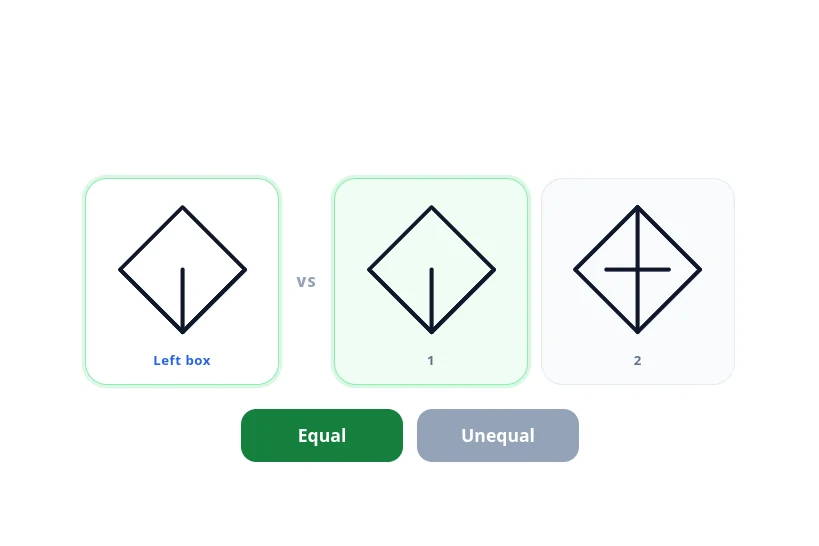
New FEAST Module: Scan And Compare Figures Is Now Available
Scan And Compare Figures is now in the FEAST Preparation Suite. Compare the left figure with the fig...
Read More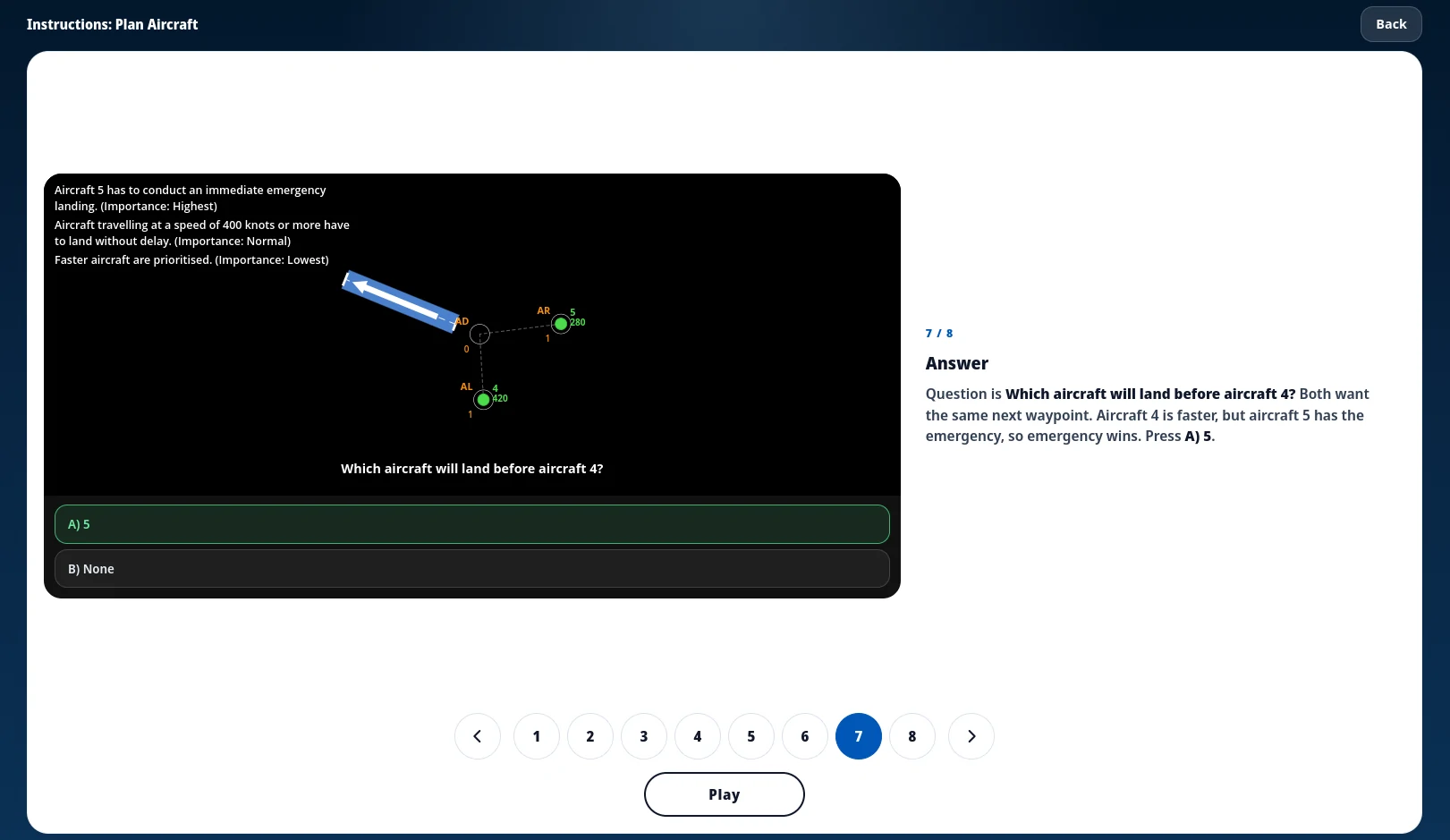
Every FEAST I Game Now Starts With Instructions
FEAST I modules now open with a short walkthrough of the board before the timed round, and the same ...
Read More