How to Prepare for FEAST II: Work-Sample Training Guide (2026)

Start practicing FEAST II
Train DART, Multi Pass, and Radar Control with guided tutorials, difficulty tiers, and saved progress in the FEAST Preparation Suite.
Passing FEAST I opens a second gate. FEAST II is no longer about isolated cognitive items on a timer. It is a work-sample stage where you keep several task streams alive at once, often for ninety minutes or more per module.
EUROCONTROL describes FEAST II as one or two multitasking tests that generally follow a successful FEAST I result: the FEAST RADAR test and, at some organisations, the FEAST MULTI-PASS test. Each can run between one and a half and two hours. No aviation background is required; instructions are detailed and include practice items before scored sections begin.
This guide stays on that second stage only. For the full battery overview, read Understanding the FEAST Test. For FEAST I module breakdowns, see FEAST Modules Explained.
Last updated: August 4, 2026
Before you train: Not every FEAST user organisation runs the same FEAST II configuration. Confirm which modules appear in your invitation. ANSPs may also add non-FEAST steps or interviews after this stage. When your recruitment email conflicts with anything here, follow the email.
What changes after FEAST I
FEAST I measures component skills: memory blocks, spatial rotation, divided attention drills, English comprehension. You finish one task type, then move to the next. FEAST II keeps the pressure on a single integrated screen where radar monitoring, strip or label work, audio cues, and secondary checks overlap.
The shift is not raw difficulty alone. It is sustained allocation of attention. Candidates who cleared FEAST I on accuracy sometimes stall in FEAST II because they try to perfect one subtask while another queue fills. The scoring model rewards stable partial performance across streams more than flawless work on a single channel.
- EUROCONTROL publishes
- FEAST II exists; it follows FEAST I; it includes RADAR and possibly MULTI-PASS; each test runs 1.5 to 2 hours; multitasking is the core construct; no prior ATC knowledge is assumed.
- EUROCONTROL does not publish
- Exact traffic densities, subtask weights, pass thresholds, or item-level scoring rules for RADAR versus MULTI-PASS. Cut scores are set by each user organisation against its candidate pool.
- Worth internalising
- You are unlikely to complete every demand perfectly. EUROCONTROL's FEAST I guidance applies by analogy: work quickly and precisely, and do not assume unfinished items mean automatic failure.
Work-sample profiles you may face
Names below follow EUROCONTROL where possible. Independent preparation tools sometimes add corridor-style radar scenarios that extend the same skill set; treat those as training depth, not as a guarantee your ANSP uses them.
FEAST RADAR (dynamic monitoring)
Official role: EUROCONTROL lists the FEAST RADAR test as a core FEAST II work sample. It presents dynamic traffic on a radar-style display and requires continuous monitoring plus timely responses as situations evolve.
Load pattern: Visual tracking stays primary, but secondary prompts often appear: heading changes, conflict checks, or parallel inputs that must not interrupt separation awareness. Fatigue shows up as missed peripheral aircraft, not as slow typing.
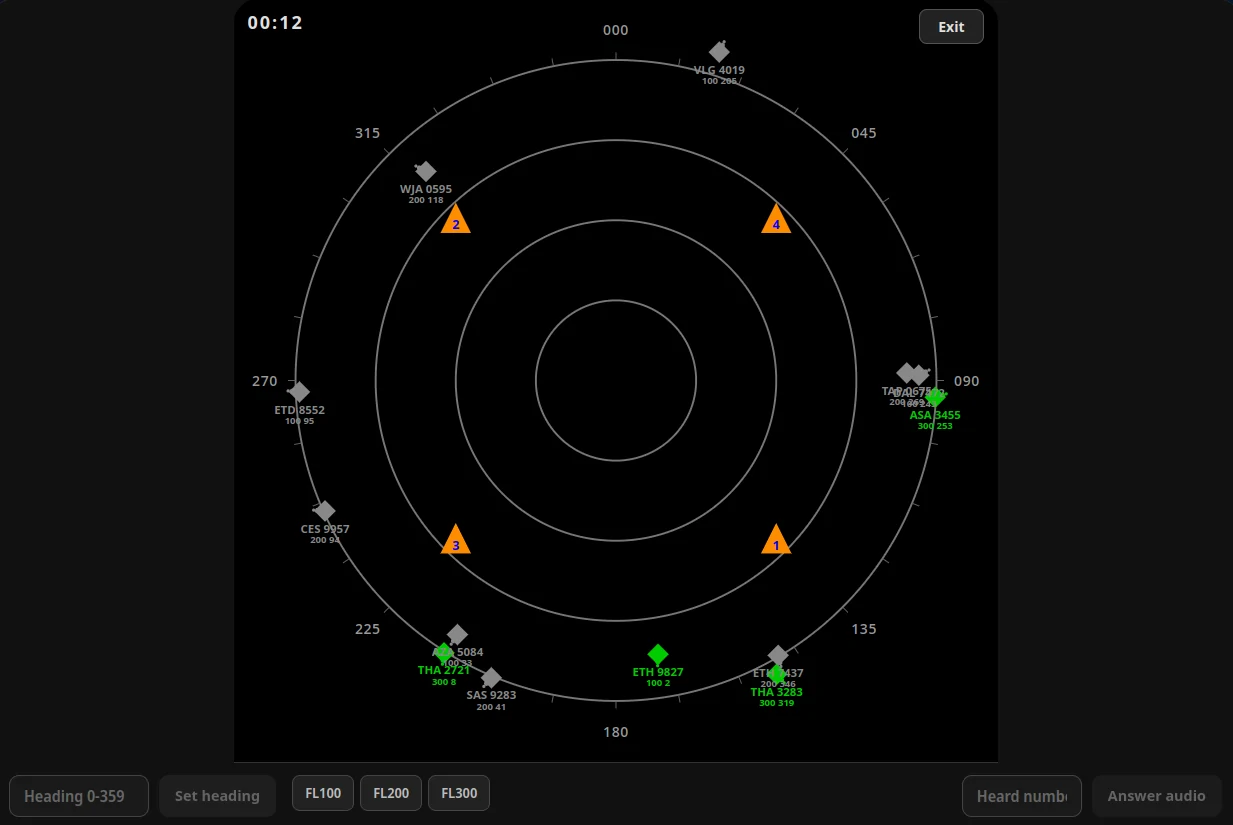
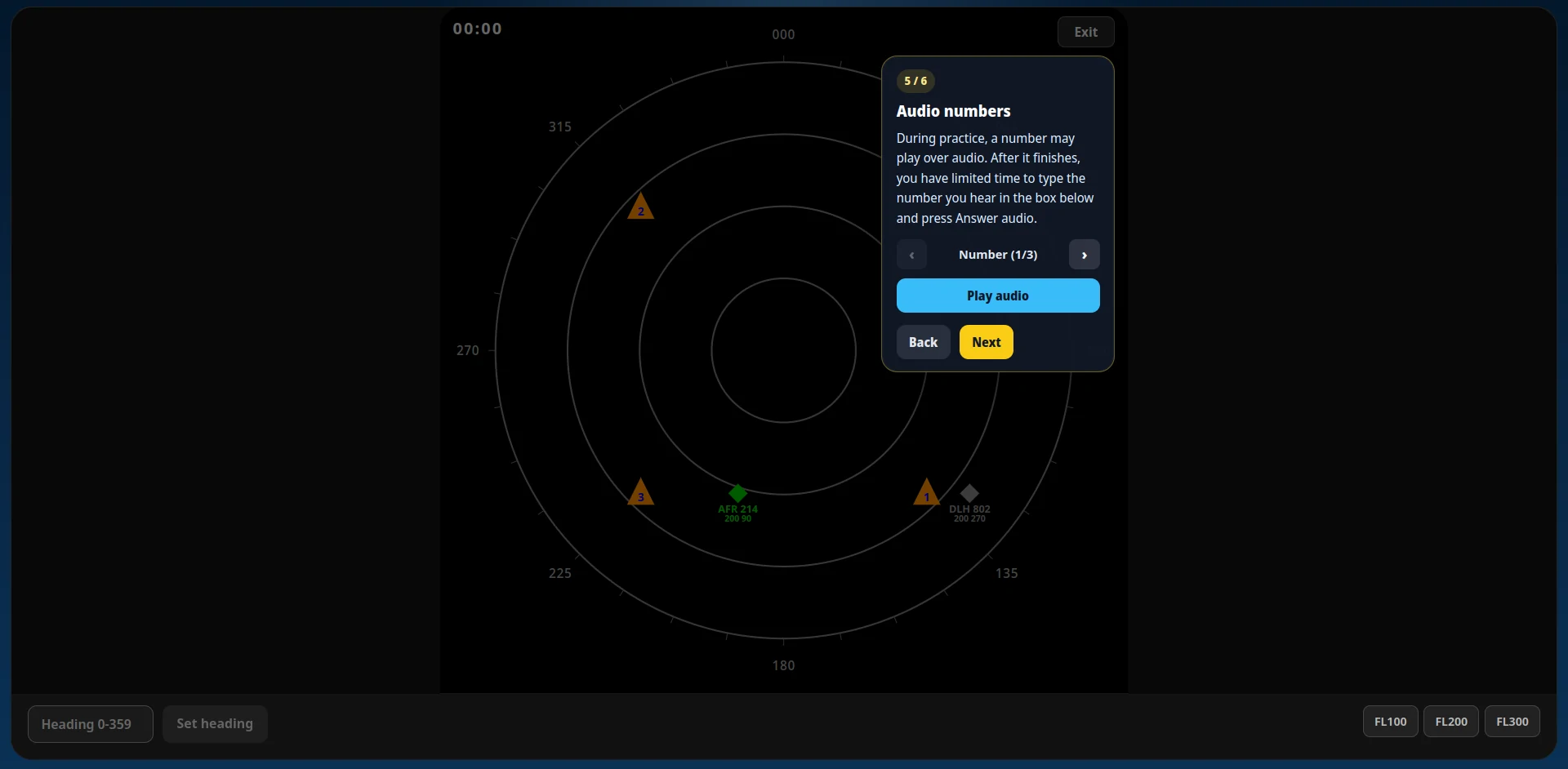
Prep focus: Build a fixed scan rhythm before you optimise routes. In our DART module, candidates practice the same split-attention pattern: keep the scope picture stable while clearing side tasks. Start with tutorial mode in the FEAST II section of the suite before jumping to timed levels.
FEAST MULTI-PASS (coordination under load)
Official role: EUROCONTROL describes MULTI-PASS as a possible second FEAST II test focused on managing several concurrent demands: traffic coordination, prioritisation, and workload that mirrors controller multitasking.
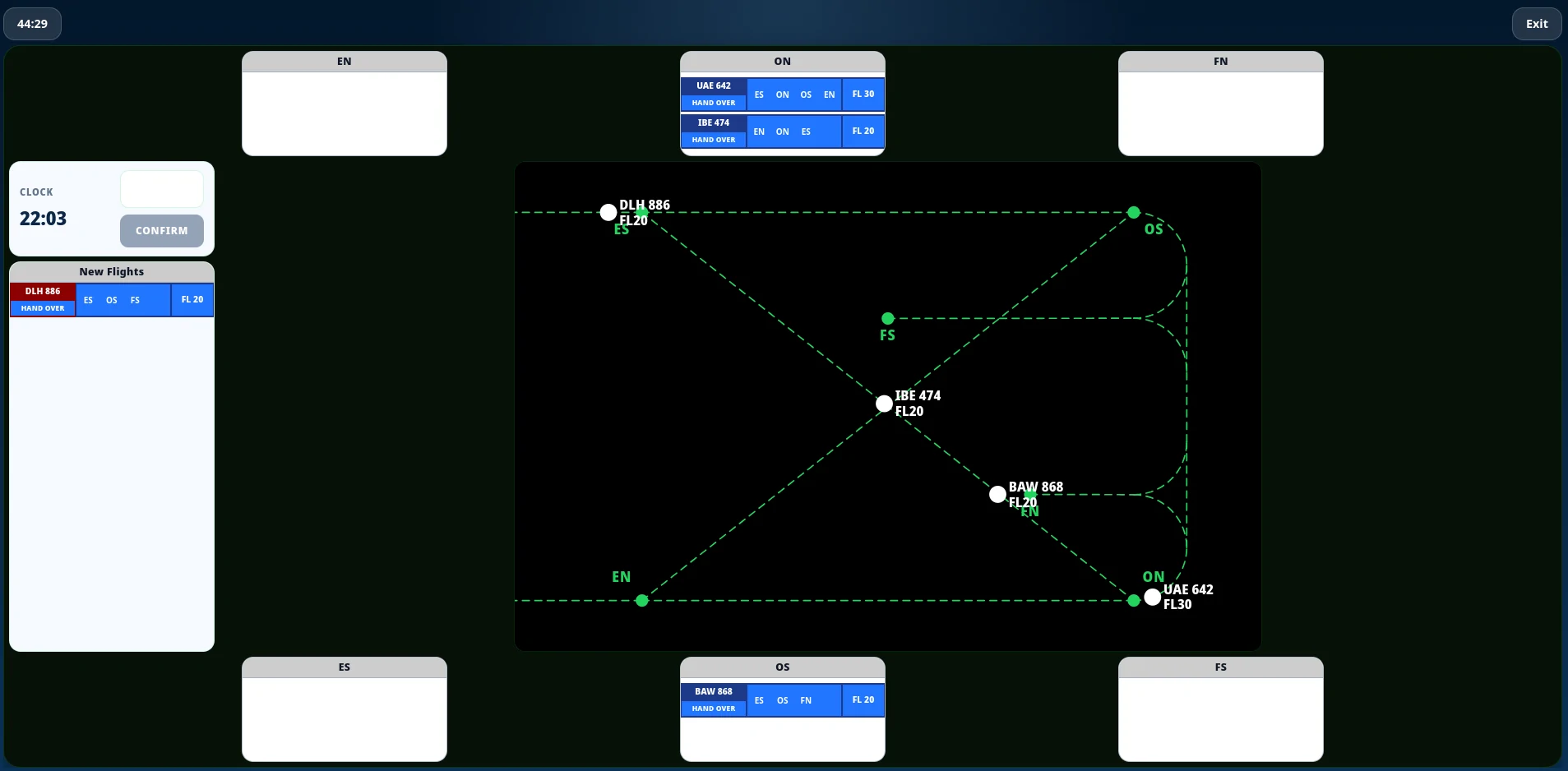
Load pattern: Strips, waypoints, handovers, and audio callsign tasks tend to stack rather than alternate cleanly. Errors cluster when candidates classify correctly but hand over at the wrong moment, or chase audio while ignoring strip status.
Prep focus: Write a short process card and rehearse it until automatic: classify, confirm position against the rule set, hand over only when criteria match. Multi Pass in our suite trains that sequence under rising traffic. Pair it with guided tutorials if the full interface feels dense on first open.
Corridor-style radar control (organisation-dependent)
Official role: EUROCONTROL's public candidate site names RADAR and MULTI-PASS only. Some FEAST user organisations and preparation environments also use sector-style scenarios where aircraft enter at one boundary and must reach defined exit points through a simplified airspace.
Load pattern: Route planning and separation compete for the same working memory. Candidates who micro-manage every degree of turn lose the sector picture; candidates who zoom out too far miss conflict pairs building in choke points.
Prep focus: Practice committing to a safe baseline route first, then adjusting only when separation margins shrink. Radar Control in our suite follows that logic. Treat it as skill building for corridor management even if your invitation lists only RADAR and MULTI-PASS by name.
The priority stack inside any FEAST II module
When instructions allow ambiguity, default to this order. It matches how experienced controllers describe triage under load and aligns with what most preparation feedback models reward.
- Prevent loss of separation. Any imminent conflict override route efficiency, strip tidiness, or secondary questionnaire fields.
- Clear time-critical commands. Heading or level instructions with a narrow window outrank low-priority housekeeping.
- Keep mandatory data current. Strip updates, handover tags, or label states that gate the next action.
- Respond to audio or text prompts. Listening tasks run in parallel with radar work in many reported sessions. Ignoring them to stare at the scope costs points even when traffic looks stable.
- Optimise flow. Shortcuts and efficiency gains belong last, once the picture is safe and current.
Rehearse the stack until it feels boring. Under FEAST II time pressure, boring is fast.
A four-week preparation arc
Assume FEAST I baseline skills are in place. If you have not yet passed FEAST I, return to cognitive modules first; FEAST II simulation without that foundation mostly teaches frustration.
Weeks 4 to 3 out
Run the EUROCONTROL applicant platform at feast-training.eurocontrol.int to confirm keyboard and mouse comfort with FEAST-style introductions. Open our suite tutorials for DART and Radar Control on easy difficulty. Goal: zero confusion about controls, not high scores.
Weeks 2 to 3 out
Alternate dedicated sessions on RADAR-style and MULTI-PASS-style modules. One day dynamic radar with secondary tasks, the next Multi Pass strip logic. Log where you abandon the priority stack. Most candidates discover they over-optimise too early or freeze after a single missed audio cue.
Week 2 out
Move to medium difficulty and full-length module runs without pausing. Add one FEAST I maintenance session weekly (divided attention or detect conflicts) so component skills do not decay while FEAST II volume rises.
Final week
Two timed FEAST II simulations on separate days, then taper. Sleep and arrival logistics matter as much as another hour of radar drills. EUROCONTROL's own guidance emphasises rest and punctuality over last-minute cramming. If you want a structured full-battery plan that includes FEAST I and III, cross-read How to Pass the FEAST Test.
Session-day protocol
FEAST II rewards composure across long blocks. Treat the appointment like a shift, not a sprint.
- Arrive early. EUROCONTROL sessions include introductions and practice items; rushing the start wastes calm you will need later.
- Use every official practice item. Confirm how selections register, how audio volume behaves, and whether partial completion carries forward.
- During scored sections, when two tasks compete, apply the priority stack instead of restarting mentally. Resetting costs more time than a safe suboptimal call.
- If workload spikes, shorten your scan path but keep it regular. Random fixation on one aircraft is how secondary queues silently overflow.
- Between modules, stand, hydrate, and reset posture. FEAST II spans hours; physical stiffness shows up as missed peripheral cues.
Where independent practice fits
EUROCONTROL's free platform is the official starting point and covers general FEAST principles. It is not a byte-for-byte replica of live RADAR or MULTI-PASS sessions, and public materials emphasise FEAST I familiarity on that site. Many candidates therefore add structured work-sample repetition before FEAST II invitations arrive.
Our FEAST Preparation Suite groups DART, Multi Pass, and Radar Control under FEAST II training with tutorials, difficulty tiers, and saved performance history. It is a subscription product separate from the English and personality add-ons some ANSPs schedule around the same hiring cycle. Use it to build multitasking stamina, not to memorise specific items that will not appear on test day.
If FEAST II does not go as planned, retest rules vary by organisation. EUROCONTROL generally advises taking FEAST once; individual ANSPs set their own re-sitting policies. See what happens if you fail the FEAST test for how to read feedback and plan a second attempt where allowed.
Questions candidates ask
Is FEAST II harder than FEAST I?
Different, not strictly harder. FEAST I tests whether you possess baseline aptitudes. FEAST II tests whether you can deploy them concurrently for extended periods. Candidates strong on isolated puzzles still fail FEAST II when they cannot maintain parallel task queues.
Should I prepare for MULTI-PASS if my invitation mentions only RADAR?
Prioritise what your ANSP confirms. If the invitation is silent, ask recruitment before investing heavily in MULTI-PASS-only drills. RADAR preparation still transfers: scan discipline, conflict awareness, and secondary-task recovery appear in both modules.
Can I use third-party FEAST II software?
EUROCONTROL advises against unauthorised preparation products and points candidates to its own training platform. Independent tools, including ours, exist because many applicants want repeatable work-sample volume beyond official demos. Treat any third-party score as training feedback, not as a predicted FEAST result. User organisations own your official outcome.
Related Blog Posts

How to Become an Air Traffic Controller (2026 Guide)
How to become an air traffic controller in 2026: eligibility, age limits, selection tests, and train...
Read More
What Skills Do You Need to Be an Air Traffic Controller?
The skills air traffic controller selection actually measures: spatial awareness, working memory, mu...
Read More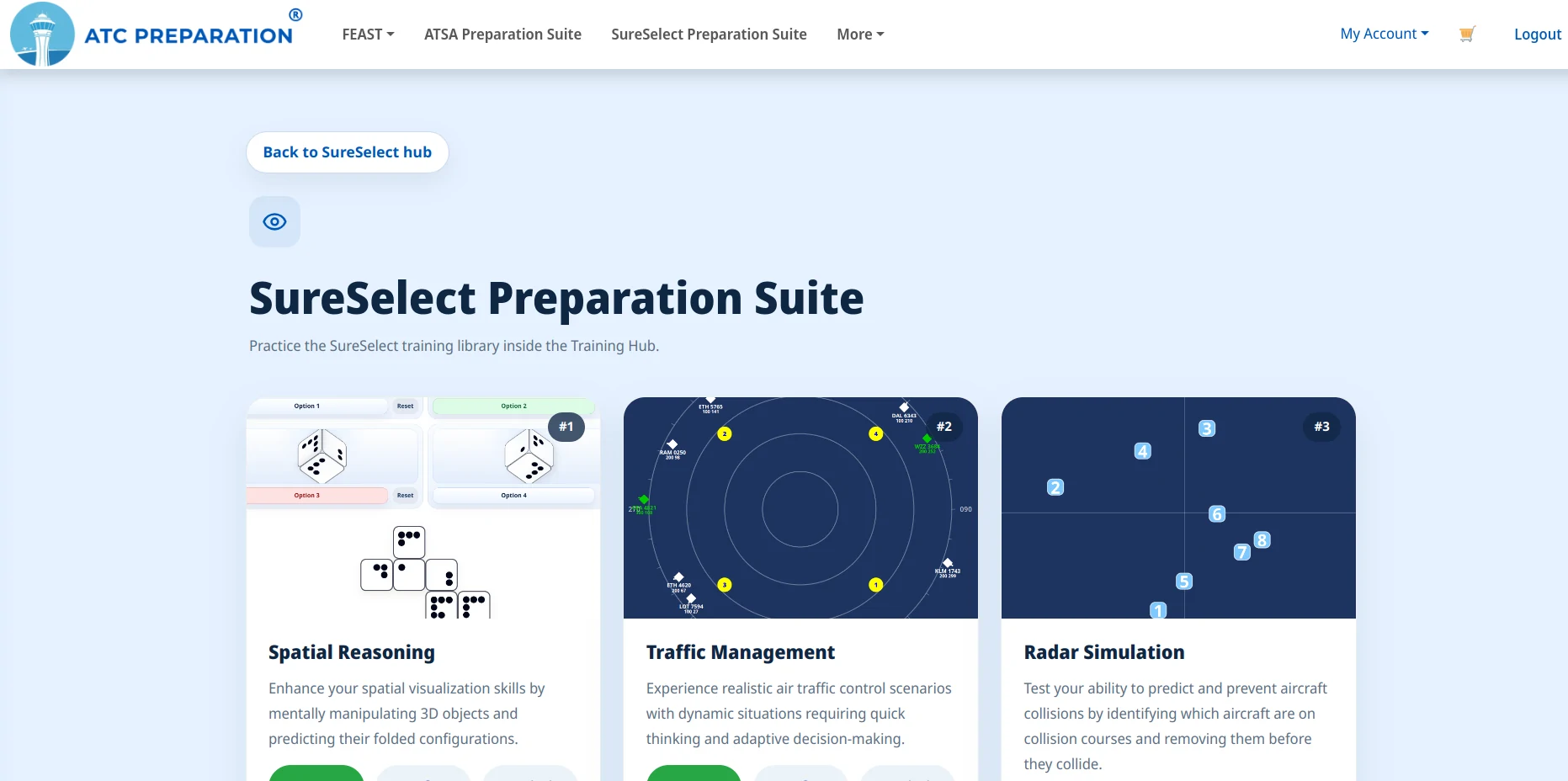
SureSelect Preparation Suite (2026): What Each Module Measures and How to Prepare
What each SureSelect Preparation Suite module trains: cognitive ability, ATC skill simulations, and ...
Read More